
The third iteration of Doug Bolden's various thoughts and musings.

Tag: Doug Rants

Chewing on a Proper “Self-Hosted” Web-Sphere: Very Early Thoughts

Photo by Nick Karvounis on Unsplash

It wasn’t technically Daniel Sell’s “How to Stop Jumping Ship” that made me start thinking about the topic of this post, but that is a linkable resource that has some of the information that has filtered into my brain space:
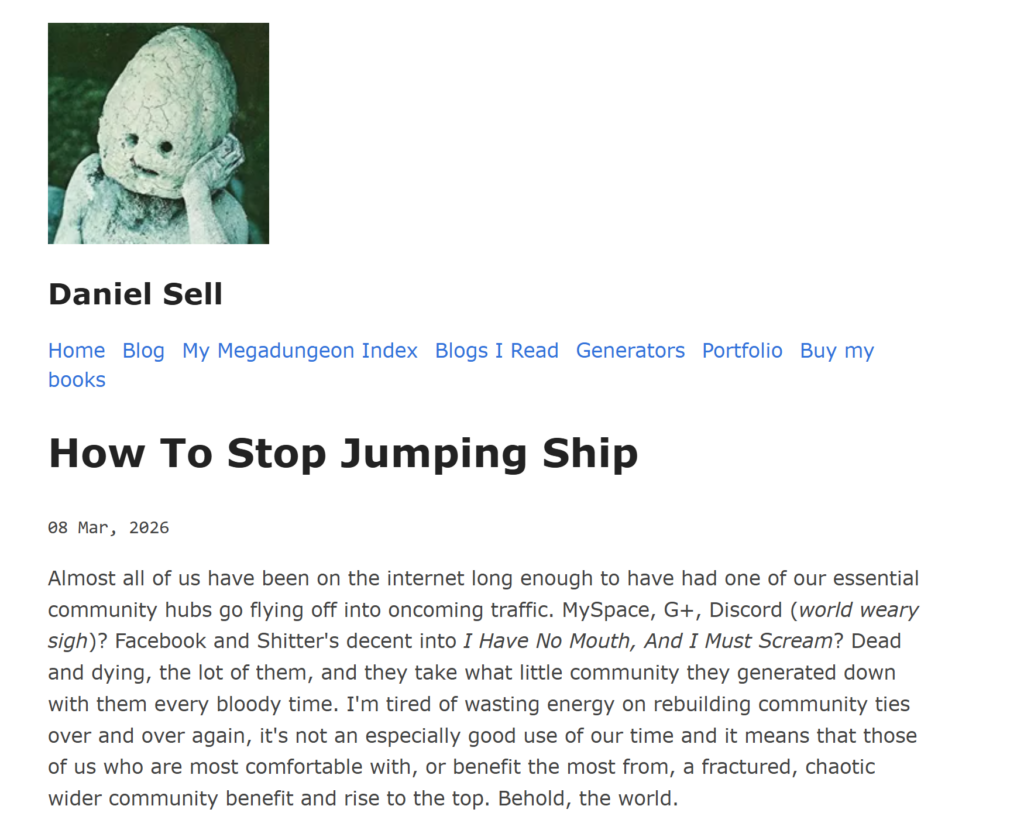
How To Stop Jumping Ship
08 Mar, 2026

Almost all of us have been on the internet long enough to have had one of our essential community hubs go flying off into oncoming traffic. MySpace, G+, Discord (world weary sigh)? Facebook and Shitter's decent into I Have No Mouth, And I Must Scream? Dead and dying, the lot of them, and they take what little community they generated down with them every bloody time. I'm tired of wasting energy on rebuilding community ties over and over again, it's not an especially good use of our time and it means that those of us who are most comfortable with, or benefit the most from, a fractured, chaotic wider community benefit and rise to the top. Behold, the world.

Important bit from slightly below that:

So I propose…we just toss it all in the bin and go back to the beginning. Blogs, newsletters, IRC, mailing groups, and, sure why not, Usenet, go nuts…These things are time tested, functional even in the face of overwhelming lack of interest from the general internet, and are, most importantly, utterly unbreakable. A specific blog, irc etc etc might disappear, but that won’t take anything besides that one facet of a larger whole with it.

What actually started it was an email which was sent out to the Melsonia email list. Same sort of information, a bit more pithy:
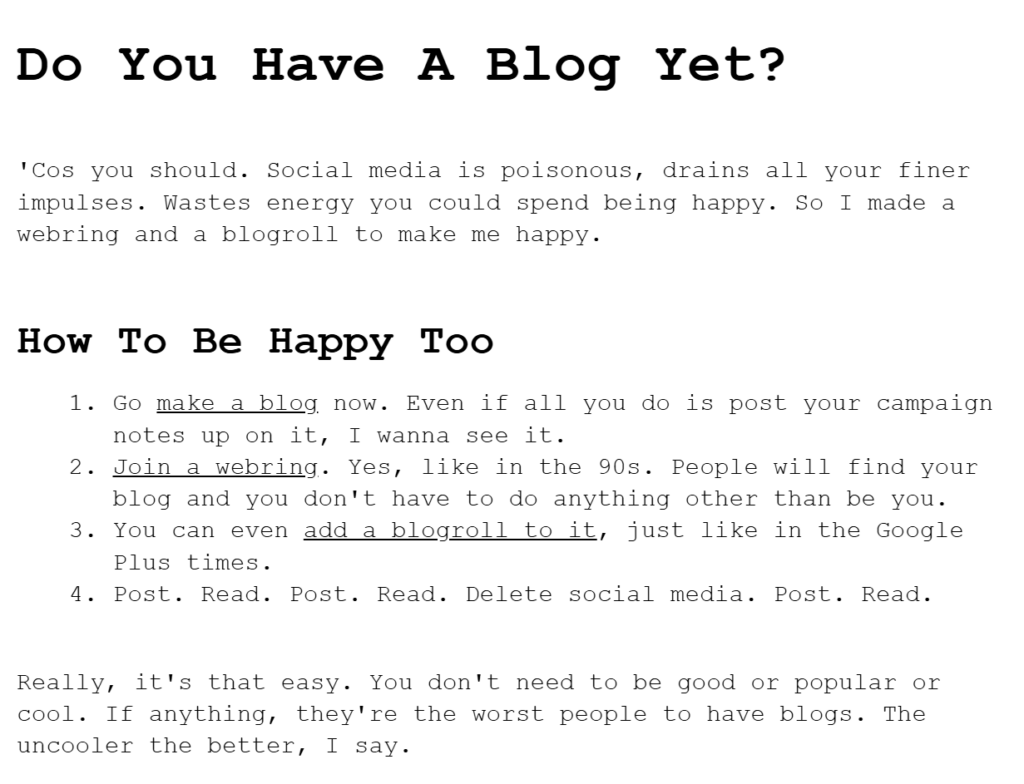
Do You Have A Blog Yet?
 
'Cos you should. Social media is poisonous, drains all your finer impulses. Wastes energy you could spend being happy. So I made a webring and a blogroll to make me happy.
 
How To Be Happy Too
Go make a blog now. Even if all you do is post your campaign notes up on it, I wanna see it.
Join a webring. Yes, like in the 90s. People will find your blog and you don't have to do anything other than be you.
You can even add a blogroll to it, just like in the Google Plus times.
Post. Read. Post. Read. Delete social media. Post. Read.
 
Really, it's that easy. You don't need to be good or popular or cool. If anything, they're the worst people to have blogs. The uncooler the better, I say.

Pretty much everything in that image is in the above linked post, though one addition is very much in-line with the stuff I talk about here, which I’ll quote:

Social media is poisonous, drains all your finer impulses. Wastes energy you could spend being happy.

He includes a link to Bear Blog which I won’t include because I’m sure it is fine but this is not an endorsement of a particular product over the other and at a glance, the software seems to violate a couple of principles I’ll talk about in a minute.

If anything, this post is absolutely an anti-endorsement of anything that might be considered a product. Websites/Apps-as-products are killing us. Killing the earth. Killing creativity.

I Digress All Over The Algorithm

One caveat creeps up almost immediately: Sells and I are at least partially concerned about two different things. He seems to be largely talking about (a) moving towards a platform where ideas exist outside The Platform® and are not beholden to the constant drive towards enshittification and profits AND (b) coming up with something that trumps the Algorithm Class’s version of a good time. I like both of those things, both fit strongly in my Reclaim Ownership concept I have been discussing here or there on the blog, but I think for me there is something else brewing in my brain:

Stop treating the Algorithm Class like your friend: you are a commodity to them and the current internet is designed to take resources from you and feed your resources into their bank accounts [money they use to take more freedoms from you].

We are witnessing the death of ownership and are being manipulated into thinking we need them. In 2026, The Algorithm tells you you are bored, that you are unhappy, that you are worthless without The Algorithm, that your replacement worth is derived from the dopamine you get from participating in a rich-person’s profit margin. And we believe it…

Come and share! Like and subscribe! Upvote! Get your five-year streak!

We live in a world where we give third-party companies all the content that makes the platform worthwhile but then you give up increasing rights to your own creations as they rapidly change the rules. They don’t even ask nicely. They just have your college friends’ content being held hostage and you are lonely.

AI amoebae demanding access to our creations. Less control over what we can share versus keep. Free-fall user unfriendly design based around selling digital baubles. Digitally engineered loneliness and disease. All the other terrible aspects forced upon you while specialists in behavioral modeling outsource whitepapers to tell the owners of the servers how to maximize profits from your work.

It’s Big Tobacco all over again. Paying experts to make things more addicting while telling us they are just giving us a product we really want and rumors of your own addiction are greatly exaggerated.

With the bonus that it’s not only our creations, but often the core of our friends and family groups being held for ransom. “Keep smoking and you can keep talking to your mom back home!”

THEN, they take extra data from you and sell it.

It’s like the worst possible version of the peer-review process. That process has volunteer writers being edited/scored by volunteer editors and volunteer peer-review committees. Then the output is given freely to scientific publishers who generate substantial profit off making it available. With the consequence of not publishing can include missing out on tenure and promotion.

Only instead of contributing to the ever-expanding world of valuable science, we are simply trapped in a loop where in leaving a billion-dollar money maker we have no control over ends up with being branded as anti-social and distant. No party invites without social media. Missing out on collector’s items by our favorite brands because people on X got first dibs. How in the hell do we know what Florida Man is doing this week unless we spend hours each week doomscrolling through made up posts about Florida Man?

“I can’t leave Instagram, what about all my friends!?,” we say over and over as our data is stolen and the money generated from it is spent to lobby for war crimes. Taking your joy of expression and turning into AI slop generated in data centers so environmentally unfriendly they are altering ecosystems while unwriting decades of copyright and intellectual property law.

Don’t say, “If you are not paying for it, you are not the customer.” That’s tired. Sad. Ignorant. You can pay for it all day long and to The Algorithm Class you are just money and never enough.

Besides, you are very much paying for it and its the most expensive purchase you have ever made.

Like cats, there is no free social media. We are collectively paying billions of dollars to avoid going to bed on time. Our tax money spent to subsidize The Algorithm Class. In return, The Algorithm Class buying out a large portion of our governments for their needs. Every lost ecosystem and plot of land to build data centers. We are spending generational wealth indirectly to look at ads on Facebook.

And the saddest thing is that for all this money, you and your creations are worthless to them individually. Sold for pennies. A penny today so they can buy congressfolk to not pass privacy laws and make a dollar tomorrow.

That’s the thanks you get. Being sold for $0.03 on loop with no protections just so hackers can get your national ID numbers and ruin your credit while the data hoarders say, “oops,” and face no consequences.

There is no ceiling that will stop folks from generating profit off of your hard work and there are very few protections to keep you from suffering the laziness of their vibe-coding neglect.

I DIGRESS.

An Early Thought Experiment Towards Doug’s Ideal Web-Sphere

The point is that reading Sells’ post made me think about how hard it would be for me to actually get any of my friends and family on board with creating a web-ring or similar. I could probably get two or three signed up but the siren call of the wide-open for-sale web would hang there. We are two decades into the social-media-and-search-engine revolution that has stripped us of a properly free internet.

This means this is all in the heady realms of though experiment, so taking that as an act of freedom rather than problem, I was thinking of things I would like to see if I could back and shove Myspace off a cliff.

  • An actual emphasis on creator ownership, not just virtue signaling. No caveats or catch-EULAs where you give up the rights.
  • An emphasis on self-hosting or hosting done by entities where you pay them real world money to host your data and in exchange they treat it as hands off for any other use unless they pay you to use your data.
  • Related to above, but you are free to take your data whenever and wherever you please. Zero retention in a third party and absolutely no “a third party sold your stuff to another third party that has no contract with you explicitly” unlike the current real world problem.
  • “Censorship” and moderation are generated at the hands of the end-user through tools easy to read and use.
  • No advertisements unless the content creator is getting paid a substantial portion of the fee [let’s say 80+%] and at their behest [yes, this means content creators will have to pay to post stuff].
  • Multiple media streams — text, microblogging, video, audio — can be handled by servers optimal to them, each chosen by the content creator.
  • No addiction-behavior models. Discovery layer predicated by the needs and desires of the end user rather by a creation of any sort of presumed force.
  • In fact, there would be optimally many many end-user tools that have their own approach to discovery and moderation.
  • Anonymity vs ID exposure decided by content creators.
  • Absolutely NO Upvotes and, perhaps most controversial, probably NO comments posted to your own data stream [they would be posted to the commenter’s data stream]. The idea is to break apart the Skinner Box variation of the internet [as described here or there by Cory Doctorow]. You will not get algorithmically friendly shiny cookies. You share data and information and art: others can read it and watch it and enjoy it. SEO is the mind killer. SEO will pass right through you. When SEO is gone, all that remains will be memes.

In other words, something where people create content streams through many different self- or creator-focused-hosted methods and something — webrings, RSS/Atom feeds, metadata chunkers, your own eyes and fingers — will handle this and there will be no fake digital commons generating billions of dollars in revenue as long as you keep playing ball and getting your grandma to sign up for an account.

No lectures from AI-generated moderators about how you need to tweak your content to maximize conversions.

Hell, there would be no conversions. Death to the trust-economy. No product of The Algorithm Class has earned the right to addict us and constrain us to the information/data/consumption-complex they have chosen.

You decide what you want to read and no one knows what you do with it but you.
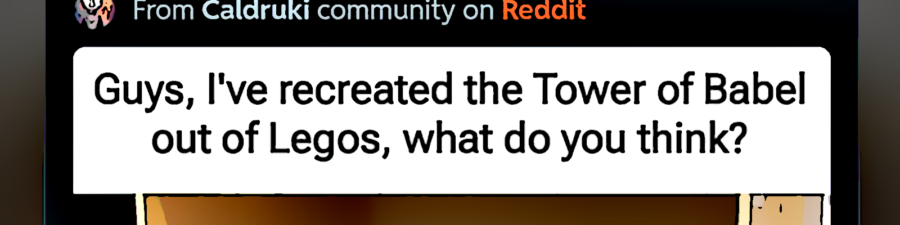
The Tower of Babbling Replies

There are a few “Explain the Joke” subreddits on reddit and most, probably all, are trash-tier karma farming circle jerks. Just absolutely awful.

The same easy-as-shit jokes or rage-bait memes are posted over and over with people showing up in the thousands to comment. Sure, some of the replies are just bots joining in on the blatant karma manipulation. Which is fitting since it is likely mostly bots posting them. Bots and people trying to farm a few easy k karma to kickstart a reddit account so they can then sell it to bots.

In fact, you could probably automate a script to block every person who ever makes a post in one and trim a fair number of crap from your reddit experience.

Some of the replies are just going to be people who can’t help correcting others or sharing their thoughts, even when the same posts show up once a week or less. It’s weaponized tribalism versus default redditor behavior.

It is especially painful because posts from a couple/three of these subreddits frequently drift to the popular feed which dirty little no-accounts like me are forced to browse without extensive bookmarks: which might be the point. Let the shit float so people are forced to make an account just to have the tools to block them. Eh. Every day is a gift.

HOWEVER, you do occasionally get gold despite the massive attempt by gravity to pull sanity off a cliff. Like this one asking about the Tower of Babel made in [not-]LEGO [look at me violating my “never link to reddit or any social media” rule].

Pardon the proximity to a pun, but my brother in Christ, what could we possibly explain? I can get folks posting references to obscure-but-knowable things with a bit of a gate-keep to even knowing search terms. Sure.

Things like the Tower of Babel might not be universally known but when the immensely searchable words are right there….

At any rate, like all good circle jerking on reddit, the scant pretense of actual joy is people running with it and the replies are full of people posting answers [some on point] in various languages….and some people then trying to argue about the true meaning of Babel. Which is like the true meaning of Dollar Store kitten calendars. It’s aliens, my man. All aliens. All the way down.

Bonus, someone ended up inserting a Hail Mary joke which will make no sense until you’ve read maybe the first quarter of the book, but still.

*jazz hands*

I look forward to this above image becoming a post on this same subreddit in a couple of days.

Is It Time for the Surprised Pikachu Face?

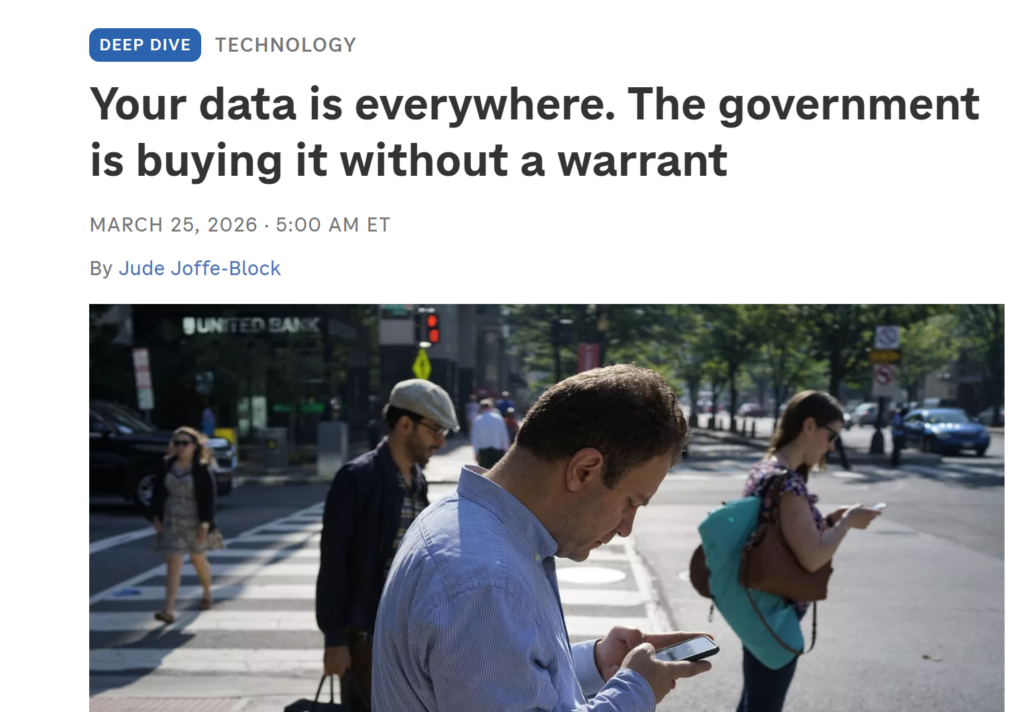
from the NPR article, Your data is everywhere. The government is buying it without a warrant:

A whole industry of data brokers buys up vast quantities of electronic information from cell phone apps and web browsers and sells it to advertisers who use that data to target ads. The same industry also sells that data, including bulk cell phone location data, to police departments and federal government agencies in ways that can reveal intimate details about Americans without a warrant.

Now, privacy advocates say that the best chance for Congress to close the well-known loophole around the Fourth Amendment that allows for that sort of governmental snooping is coming up in just a few weeks.

That’s when Congress is expected to take up reauthorization of what is known as Section 702 of the Foreign Intelligence Surveillance Act, which is set to expire on April 20.

After a 2015 change to the law, federal agencies are not supposed to collect data on U.S. citizens in bulk. But some found a workaround to requesting warrants by simply buying the data instead.

I’m actually neither shocked nor awed. Pikachu face can stay in the desk drawer. There are funnier uses for the meme. This is why I get so frustrated by conspiracy theorists. The real world changing conspiracies tend to happen in the open but are discredited by the same media and enterprises complicit in their existence [but not, you know, actually hidden].

Best bit is that AI-companies owned by the Algorithm Class is the real clear winner, here. They get paid to digest the human experience en masse to better train their LLMs by selling the data to entities that treat this data as different from protected data despite being the same data.

I have no precise takeaway here or anything to add besides to say that if our data is worth billions to someone, it should be worth [collectively] billions to us. The same way that if information wins war then information should be considered protected by the second amendment.

We’ve entered into a strange new horizon where companies revel in increasing the cost of doing business with them by, with very little choice, forcing a lot of us to give up vital aspects of our own liberty [namely the ownership of our own identity].

“If you are not paying for it, you are not the customer,” is dead, long live:

You are now never the ONLY customer.

The Algorithm Class demands a Commodity Class, and we be it.

Contemplating a Different Type of Conspiracy [Broad but Indefinite | Indifferent]

started life as a photo by Joel Muniz on Unsplash. I assume, based on date, that this is an anti-vax/anti-COVID-mandate thing. I don’t know, I just needed a clear sign that was a bit vague out of context.

Definitions and the weight of definitions are wild and easily manipulated. For instance, conspiracies by definition 100% exist and are 100% exposed — often to surprisingly little actual impact unless murder is involved somewhere and maybe not even then — on a regular basis. Let’s call these conspiracies — definite participants with definite consequences — “Tier One.”

Tier One Conspiracies: Business as Almost Usual

Company A teams up with Place B to snatch Resource C from the inhabitants. Some rich someone has an area [or company] declared low value before buying it up. Smaller scale ones where groups of people plan out crimes. Large scale ones where countries devalue a target to take over trade routes.

This is before you get to stuff like MKUltra and other exposed government plots/programs to do stuff outside of standard channels of morality/expectation. These are probably getting close to what I consider “Tier Two,” which will come up in a bit.

Tier Three Conspiracies: The Fourth Element

However, these “Tier One” conspiracies are differentiated from a different sort. I am not going to do math because it is almost impossibly complicated, but for at least some folks, perhaps most folks, this is not what is meant when you encounter the word Conspiracy Theory.

Let’s call this extreme “Tier Three.” In principle, there is a indefinite amount of agents involved and the goal seems something almost ineffable (insomuch as “Total Control” is ineffable). Like the agents behind Tier Three conspiracies are attempting godhood. Thinking about that, I’m going to propose “The Fourth Element” and discuss it in brief, down below.

There are varying lists of elements involved on this other extreme (see the European Commission’s page about COVID conspiracies to see a specific flavor), to which I would point out three (from my experience) as being deeply related to the fourth:

  • Manichean divide between GOOD and BAD and I don’t mean just simply “naughty people” but a sense that these people are akin to Biblical portions of BAD
  • Shadowy, secretive cabal of multi-faceted interests: government, business, press, science, industry, religion (“It goes deep!”)
  • Importantly: A keyhole where people who know can look through the door but said keyhole is not so obvious that it is just “clear as day” to your average person

The (often) lack of clearly defined morality, the (often) singular- or few-facet structure, and the fact that real Tier One conspiracies (usually) get spoiled violate these tenets. There’s a game to be played with conspiracy theories by my Tier Three definition where True Believers can see a bit further into the darkness and plainness.

Which brings us to the fourth element, the one I consider the key, the actual test of this tier three definition:

  • A conspiracy theory of the third tier is essentially indistinguishable from a religion requiring faith, an inner circle, ritual language, and a reshaping of worldviews and stems from the same part of our brain that processes religious conceptualization
    • THE OTHER is mostly conceptualized outwardly from THE SELF, so that different adherents will believe in variations based on their own personal history; though adherents will subscribe to the belief they are are using their faith and secret language to expose objective truth
    • There are GOOD OTHERS and BAD OTHERS talked about in dehumanizing terms, each, with the important that some OTHER AGENTs are on the side of goodness — generally the “side” of the conspiratorial belief holder themselves — and some are against it

Believing that billionaires will manipulate the market to improve their own profit margins is not, by the Tier Three definition, a conspiracy. It is plain. It involves known actors doing a possible-to-actually-know thing. You could give evidence clearly that all adherents can appreciate.

You would need to believe they are doing it to bring about an ineffable end, some great ritual, some mystic passing. In this, people who are part of the shadowy world will be both fighting for and fighting against the common person. Some billionaires will be the good ones. Some government agents will be exposing the truth behind UFOs. There will be codes and secret signs left behind.

However, I am left with the sense that there are broad movements and there are general shifts by powerful players but not codified in quite the same way. What if snack companies push less-filling, brightly colored snacks not because they are working for Satan (to ape a chain letter of many years ago) but because they want you to get fat and feel like a loser for not choosing one product from one of their subsidiaries over another of their subsidiaries?

Towards a Tier Two Definition

Which is making me wonder if there’s not space for a Tier Two definition:

  • TIER ONE: DEFINITE agents for a DEFINITE purpose.
  • TIER TWO: (largely) DEFINITE agents for a perhaps DEFINITE purpose but through INDEFINITE instability.
  • TIER THREE: (largely) INDEFINITE agents for an INDEFINITE or DEFINITE purpose (but usually the DEFINITE purpose is a facet of a much larger INDEFINITE one).

Look, it’s a broad musing and a work in process. I know this is fallible. I’m chewing on it. This is the part of the canvas where I have to throw paint all over the room just to figure out which colors match. Much like the algorithms that push various problematic memes to see which one stick and be manipulated into generational trauma…

*wink*

What I’m wondering, though, is if you could have a group of people — maybe not precisely known at present but in principle definitely knowable with clearly defined lines — who interfere with things, perhaps in definite ways, usually with a definite goal, but with indefinite consequences.

Which is wrong. Throwing paint, like I said. It’s more like…

Generating indefinite instability in order to generate certain types of behavior in the short or long term with the assumption that some classes of people are more immune to large and small scale instabilities.

One odd aspect of this “Tier Two” is that…

  • It’s not necessary for every agent group to be actively working together, just that they are participating in trends towards instability

A Tier One conspiracy would be like, say, a tobacco company or conglomerate of said companies making cigarettes more addictive. A Tier Three would be tobacco companies making cigarettes more addictive so that people absorb more chemicals and become conditioned towards government mind control backed up by a shady group of academic elites.

This type of Tier Two I am talking about would be various companies following trends of marketing and science to general make their product more addicting but then also paying for advertisement and education against addiction to harm competitors but also to increase distrust in science and regulation amongst their addicted regulars. Either they win by creating tribal-like brand dependency or by having people eventually thinking that “both sides” are problematic.

Oil companies making broad statements against renewable energies while also co-opting and sometimes controlling green initiatives for instance. Where wind power’s actual impact on local ecosystems can be treated as just-as-bad-as the extinction level event that fossil fuels can represent.

Complain about fossil fuels? Why do you hate small communities in Africa?

Promote veg*nism and a move from factory farms? That’s racist.

Algorithms pushing coverage for relatively minor infractions by environmentalists vs an over-emphasis on largely meaningless gestures. People being bullied for personal responsibility over the environment catastrophe vs people being portrayed as powerless against effective change (aka “the paper straw” strawman bullshit).

Co-opting “freedom of speech” as a way to attack personal freedoms. Or changing the meaning of “fake news.”

Algorithms that highlight catastrophizing and doom-scrolling. Creating a media landscape where brain-rot short-form media is both becoming a default and also complaining about it is becoming a default.

AI discussions where complaints or praises of it mean nothing because your average user cannot do a goddamned thing either way. Right up to complaining about the em-dash and oxford commas and all the other ways anti-AI sentiment is being used to dissolve standards of human communication. And yes, I filled this post with hand-coded — just to be pissy. I had to click extra for that shit.

Where Gen X was sold both anti-establishment and pro-establishment media. Anti-intellectual and pro-intellectual media. Told to trust the scientists we were told to mock as eggheads. Told to trust the government we were told to hate. Told to eat the food we were told to hate.

Where the only consistent thing was that we were told to consume.

To choose sides. To choose no sides. To engage. To be enraged. To qualify things that should be quantifiable. To quantify things of indefinite qualities. Where even the “generational system” of organization — Gen X, Millennials, etc — is nothing but bullshit pseudo-science to make us feel like we are striving for a horizon that has never existed. And if you complain about the labels? There’s a label for that, too.

“Here’s a box, get inside, please. Oh, don’t like the box? Me too! I hate boxes, subscribe to my newsletter!”

Because in the end that’s all that matters. Not the stance that we take. Not that we take a stance. There’s no stance we can take. As long as internalize it, though, as long as we think the stance or lack of stance is a thing, we consume. Just to show them.

That’s what I’m talking about. Where it’s not just about the doubt vs belief, identity vs the unknown, embracing conflict vs finding compromise: it’s about how we internalize these things and keep clicking more links. Thinking we have to fight but never quite knowing what it is we are fighting (plot twist: we are fighting our wallets to sign up for more online services, quite often). Thinking we are doomed but we might as well be playing on the Titanic and then getting fucking furious at people for playing on the Titanic while not thinking they are doomed in the exact same way.

We end up terribly judging who are just as intellectually complex and emotional extant as ourselves because the goddamned algorithm needed there to be an A and B or what the hell is A-B testing for?

I have to go chew on this and make more sense on approach two, assuming I get around to it.

The “Cool Vegan” Letter

You occasionally come across a response or opinion that catches you off guard. The world is a rainbow and there are spectra within spectra, so I am never expecting everything to make sense to any of the MillionBillion Dougs, but still…

Name is obvious retracted, but the source was The Guardian which kind of spoils my obfuscation but I like to cite my sources.

Apologies for any readers with sight issues, but I’ll not quote it in full [see link in caption to find more] but the gist is that the person wishes to see more foods catering cool vegans and vegetarians. The opposite given would be foods like “vegetarian curries and chilli dishes.”

The first thing that caught my eye was simply the use of cool in the presumed context of “people who do not like spicy.” It is potentially a double entendre of sorts, the non-sexy kind. I tried to find if that was a common speech pattern [“cool foods”] and mostly found a website dedicated to more carbon-neutral eating and another blog that hasn’t posted in a few years.

In principle, it reminds of a complaint I read years ago in the comments on Vegan Black Metal Chef‘s videos: that vegans can only stomach their food by making it too spicy. There was a period where it was one of the gotcha arguments against plant-based diets. You can still find some remnants if you search online.

The broad argument, which I am absolutely not claiming is being cited by the letter writer [it seems more likely that they had a few dishes that were all of the spicy version and is making an incorrect generalization], is asinine and untrue. The fact that it almost always coupled with the sibling argument that meat-based foods are just more filling, flavorful, and satisfying without requiring spices is a fake you are being tricked into accepting as face value.

This is leaving aside that some variations of these arguments are clearly framed in racist tones. It’s ok, you also have arguments that veganism is inherently racist. It’s a balancing act.

I’m not sure what the logical fallacy would be called but the structure would go like this: Option A is a problem (based on Opinion C, which may or may not be related to either A or B in truth), therefore Option B must be better though I will avoid discussing it at any depth.

For example, countries with snow can make snowmen and snowmen are fun for children therefore countries without snow are bad for raising children. I’ve created an arbitrary line to judge two elements and then stated those two elements in the context of this line in a way that makes the responder think they have to respond directly to context of the line. It’s the big sister version of “Yes or No, X is bad” and then not allowing any nuance. Tracks great for snippets but not in the real world where very few things are that simple.

Because the spicy plant-based/forward food option is overwhelmed with evidence to the complete contrary.

Not only do many of the same cultures that spice their vegan dishes also spice their non-vegan dishes, the implication that someone craves meat at all times is just false.

Tastes vary greatly by all sorts of factors. As a plant-based American in Europe, I can say from some experience that most “spicy” dishes here are far below the spice tolerance that would be expected back in the States. In our recent trip to Glasgow, even some of the spiciest dishes barely triggered a proper spice response in myself (the Hot Cock is the main standout, thanks Buck’s). The only inverse I have seen is that Delhaize sells a vegan burger [sorry, EU] that has a bit too much cumin. Making it taste more like a sausage patty than expected.

A huge amount of our food stuffs are just naturally plant-based and plant-forward. Yogurt. Olives. Mashed potatoes. Fries/Chips. Bread. Scrambled eggs. Cheese [minus the rennet]. Tofu. Seitan. Hummus. Beer [minus the isinglass]. Ice cream [whether it is made with soy or cow’s milk]. Beans. A lot of soups are so close that it is trivial to cut out any meat. Gravies [at least can be made such]. Puddings. A lot of breakfast cereals that do not have gelatin-based mini-marshmallows [including the vast porridge family]. Muesli. Fruits. Vegetables. The list is extensive. Pizza and pasta is already right there and they are especially easy to play with.

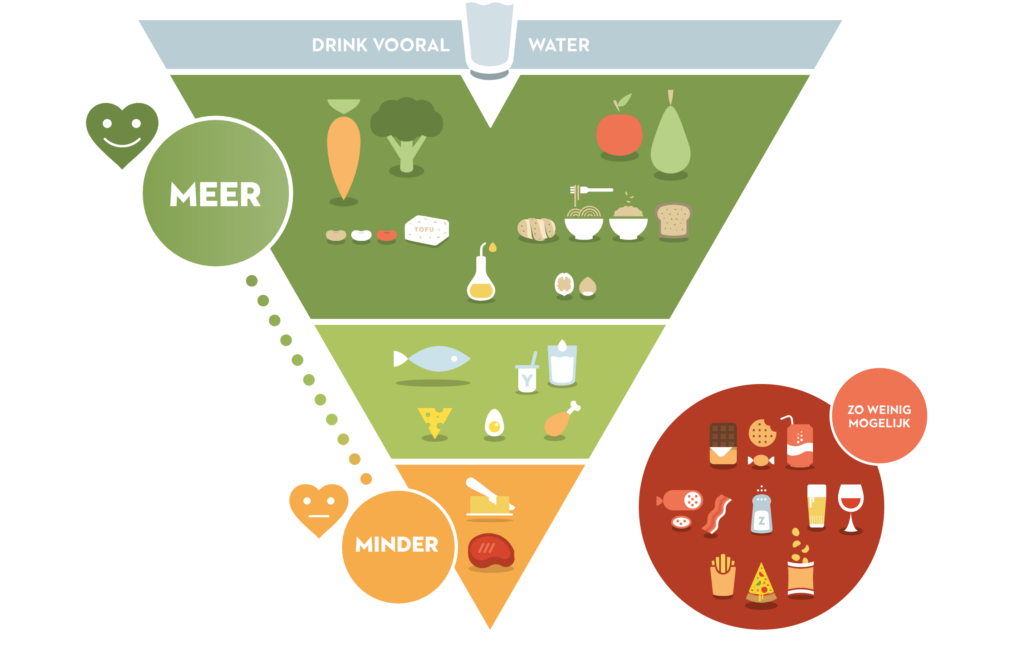
In the usual “food pyramid” type structure, the only bit that isn’t plant-forward is the meat/fish/fowl segment(s). And with the notion that many breads and “calcium-group” items can be made or “replicated” without any animal products at all means only the minority is non-vegan. A few lentils, beans, quinoa, or what have you can cover that gap. It’s actually easier than that to get plenty of protein.

However, a huge amount of food-centric dialogue tries to claim that the second narrowest slice of the food plate/pyramid/etc [only “snacks” is smaller] is the core of the food experience. Sometimes aggressively so.

Fun fact, the Belgian food pyramid (or, at least, one of them) is inverted and has white meat in with the melk-en-kaas category and puts bread up in the eet-meer category, which feels so properly Belgian (though they put beer, chocolate, and fries in the “little as possible” category which is a shocking betrayal).

“Vegans are giving up an important part of their diet and abstaining from the full experience,” is another common fallacy that tries to liken abstaining from meat eating as something akin to self-hatred. Most food is veg*n. By centering every maaltijd around the vlees, you ignore so many flavors and structures inherent in meals.

My advice, then, if you are looking for “cool veg*n” foods, to just take a look at what you eat and eat that. Toss in some ready-made vegan food if you need (Beyond Burger, whatever). If you are at a restaurant, then ask them to tone down the spices where possible.

Another option is to use something like HappyCow to look up plant-based and plant-forward or at least plant-forward-friendly restaurants in your area.

If you need quick meals, then start with the fruits/veg options and toss in some hummus and bread. Tweak, ad infinitum, to your heart’s content. Once you stop having to start with the question of “What goes with the chicken?” you start to realize that food has so many variations that have been broadly locked out by the so-called common sense of the meat-and-two-sides meal structure.

EU to (possibly) Enforce Stricter Naming on Vegan Meat Substitutes

I write the following with two perhaps important caveats:

  1. I am an American citizen currently under the auspices of the European Union and enjoying the delightful country of Belgium for work- and family-related reasons and therefore mostly have a stake in this “fight” in that, for a period of a couple of years, I will be eating Belgian (et al) food.
  2. I consume a plant-based diet (though lean more towards beans and tofu than pre-processed “meat substitutes”).

Stricter Naming for “Meat-Alternatives” Vegan Products

The European Union Parliament has voted to have stricter naming on vegan meat substitutes (BBC). Other articles are covering it:

And Arjen Lubach gives a nice rant about it which is actually where I first heard about it because, once again, The Algorithm and I have not yet come to terms. His video is in Dutch with English subtitles available. I appreciate his sass.

Finding Context and an Actual List of Terms

Perhaps the best overall context I have seen is in Politico.eu’s “EU lawmakers back ‘veggie burger’ ban”:

The ban, proposed by French center-right lawmaker Céline Imart, was buried in a broader reform of EU farming rules designed to tweak how farmers sign contracts with buyers and adjust a raft of other technical provisions. It was one of more than 100 amendments MEPs decided on at their sitting in Strasbourg.

When the numbers flashed up on the screen — 355 in favor, 247 against and 30 abstentions — Imart looked visibly relieved and drew a round of applause from her colleagues. The overall reform package, including the ban, was later adopted by a comfortable margin.

Following the links in that article, the actual terminology is explained. Adding to a list of suggested “reserved for meat products only” terms introduced in the utter mouthful of the Annex 1 (PDF) to, deep breath, the “Proposal for a REGULATION OF THE EUROPEAN PARLIAMENT AND OF THE COUNCIL amending Regulation (EU) No 1308/2013 as regards the school fruit, vegetables and milk scheme (‘EU school scheme’), sectoral interventions, the creation of a protein sector, requirements for hemp, the possibility for marketing standards for cheese, protein crops and meat, application of additional import duties, rules on the availability of supplies in time of emergencies and severe crisis and securities.” On that document, pages 3 & 4 have the terms including the usual suspects of beef, chicken, pork, and rump.

Amendment 113 (PDF) is what is triggering the above articles and discussions. To the above list, it adds:

  • Steak
  • Escalope
  • Sausage
  • Burger
  • Hamburger
  • Egg yolk
  • Egg white

In the next part, it refers to poultry-meat (note: hyphenation is mine to stop spell checker from shouting at me) as a whole other broad category (via reference to Regulation (EU) No 543/2008) though most of that seems primarily contained within the aforementioned/linked proposal.

Perhaps buried a bit in the coverage is part of Amendment 113, prior to enumerating the list, states: “These names include, for example.” In other words, the above list should not be considered total or all inclusive. It essentially opens up the doors to the argument that any name understood by common-use language that might be associated with meat-adjacent production could be argued to be included by proxy. Jerky, pot pies, and maybe even certain soups and stews could be argued under such rulings.

A semi-frequent, perhaps semi-serious, debate back in the States is whether or not chili must contain meat.

I also think of terms like “sushi” or “barbecue” and how these meat-centric classes of food are perfectly functional without any animal products.

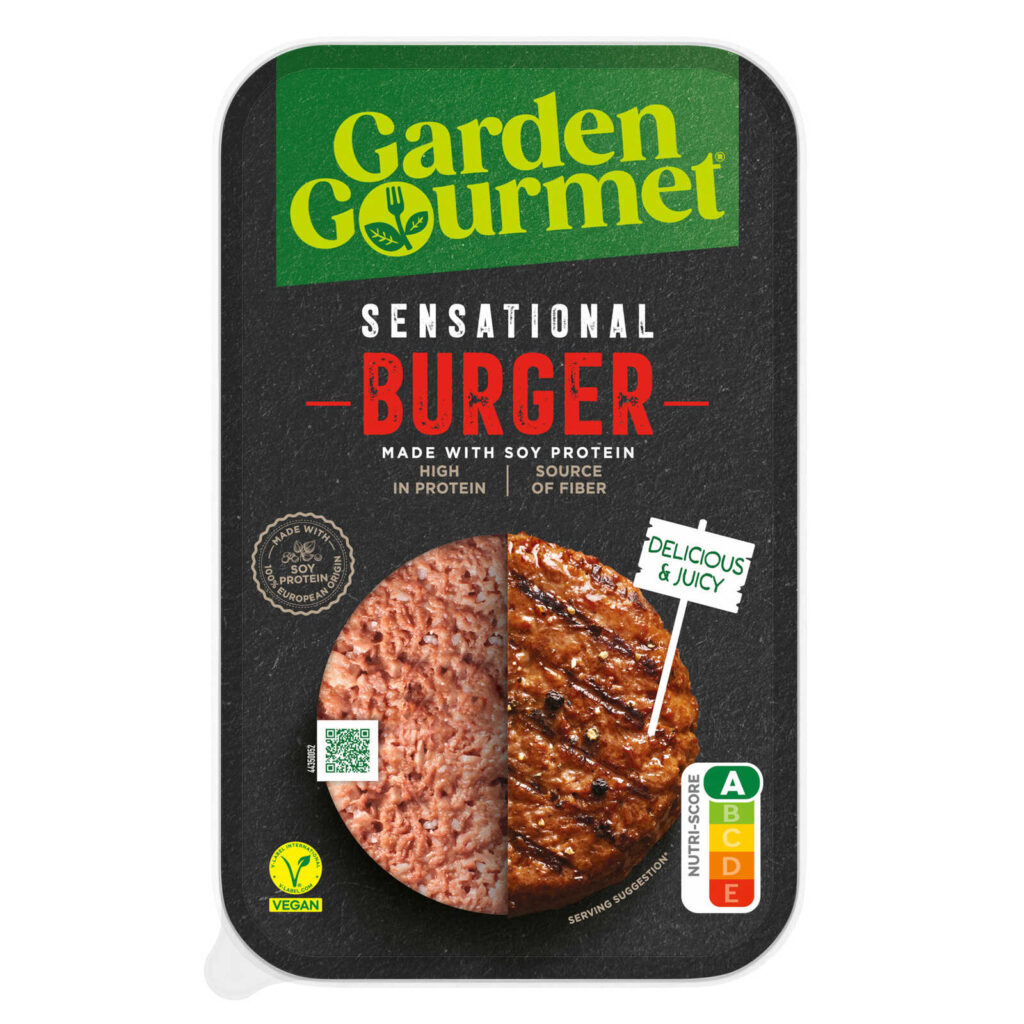
Keep in mind that the products being discussed are generally extremely well labeled. For instance, here is a fairly typical (in Belgium, other countries might vary greatly) vegan burger (via Delhaize’s website):

It is labeled as vegan, soy-based (twice), and a source of fiber (which is distinctly untrue of meat based burgers). It is also labeled as Garden Gourmet though I admit that you could make the argument that “garden” does not necessarily preclude meat.

Back in the States, there are dog treats that have less clear labels. Shout out to this one dog-treat eating redditor.

Why Such Laws at Least Slightly Bother Me (and not exactly the obvious reason)

Let me be clear, I 100% support farmers and I 100% support clear labeling. Consumers deserve options. Farmers deserve recognition as the backbone of society. Society exists as a concept because farmers make the gathering of people into cities and countries possible. It is hard damned work and they rarely get enough credit for the things they do.

Seriously, thank you.

My first issue with any such law, be it here in Europe or elsewhere, is that the conversation almost always turns quickly to consumer confusion. I feel a defined need of consumer harm should be demonstrated before the consumer becomes the main focus of many arguments. I am not sure if there is any evidence that consumers are actually confused, or harmed, by the label. If anything, such terminology helps consumers to find new products and have greater overall choice.

In the vegan space, sometimes the problem is more or less the opposite. Outside of a few restaurants that bury their vegan-lede, meat-eating customers tend to have better labeling than not. On the other hand, if you find a “garden burger” you sometimes have no idea if it is vegan, vegetarian, or just a label meaning “meat-based burger with fun root vegetables” without clarifications. I have ordered plenty of greens and beans and found out that the entire dish is just packed with bacon or ham or meat-broth. Things like kimchi might have their fish sauce component overlooked and served to vega*n customers. One Huntsville restaurant I used to love had hashbrown casserole that made with cream of chicken soup but not labeled as such.

While there is evidence of harm to traditional meat farmers, and therefore an argument fully based on the production side has merit, I am not even sure that such a ban will actually do much to protect them. A similar EU ban on the use of “milk” in reference to plant-based dairy alternatives has not slowed an increasing adoption of plant-based alternatives to replace dairy products. In fact, that’s one of my favorite things about Belgium, there’s a lot of cool soy drink to be had.

Instead, the primary benefit seems to be a chilling effect and re-labeling cost associated to producers of vegan and vegetarian products. “Minced soy patties” instead of veggie burgers or, you know…gehakte soja pasteitjes. Will that really make a difference? While you eat with your mouth and your eyes/nose, etc, the name of food only partially factors into your long term enjoyment of it. It’s not like “burger” or “sausage” or “hot dog” are particularly appetizing words in and of themselves.

I’m just not exactly sure it will actually deter sales. It will require labels, over time, to be adjusted, though, and that costs. And it reframes discussions of vegan diets into more niche terminology.

The Issue of De-meaty-fying (and Mystifying) Meat

My second issue comes out of the general class of words being targeted.

“Burger” and “sausage” terminologies are adopted by vegans and vegetarians because the words’ histories are in a huge class of products only really classified largely by rough shape and product standards.

Amendment 113 says it for me (emphasis mine):

(2) ‘Meat preparations’ means fresh meat, including meat that has been reduced to fragments, which has had foodstuffs, seasonings or additives added to it

(3) ‘Meat products’ means processed products resulting from the processing of meat or from the further processing of such processed products, so that the cut surface shows that the product no longer has the characteristics of fresh meat.

Burger is practically a neologism. Even tracing the roots as a sandwich back to the late 19th century, the general rise of minced meat being flavored with vegan additives like salt, pepper, onions, and other spices and and then shaped into a scone before being served with a light garden salad between two slices of bread is an absolute infant by historical food standards. The Oxford English Dictionary lists “burger” as being first seen in 1939. While I’m sure that fried biscuits of mince-meat are older in technology, we are not talking a particular class of bread-like meat shapes. We are talking about a specific word.

And while sausage is a much older technology (some of which are essentially “burgers,” now), one in which minced meat is combined with more vegan ingredients to give it a better flavor and then shaped roughly like root vegetables or, you know, other things, the sheer variety of presumably-acceptable-by-Amendment-113 recipes is mind boggling.

Taking the piss a bit, I asked ChatGPT to give me a rough count of sausages not including vega* options: it put the number around 1200. Then said that Germany had 1500+ of those 1200, so…you know, much like prepared-meat-adjacent-food, it is best taken with a grain of salt.

Even if you balk at using GenAI for this, there is definitely a cottage industry of books about a variety of sausage makings. And that’s just the ones currently available for sell by Amazon’s USA shop. Burgers are likewise a complexity.

And many of those recipes involve non-meat additives ranging from small amounts to not quite small amounts at all. It is the sorites paradox. When does the pile of sand become a not-pile? How much salt and pepper and vegetable matter in ground beef + beef-fat is too much?

The end result is that there are entire classes of food, let’s add in “nuggets” and “lunch slices” and “filets,” that are popular despite, or possibly because, their removal from the central meat-ness of their ingredients.

I’m more open to phrases like “egg yolk,” “bacon,” and “steak” being recognized. Of course, the latter two are also seeing a general fracturing from a particular food into a wide class of foods.

I mean, I might eat a plant-based diet but even when I was an omnivore, I would rarely wish turkey bacon on anyone.

Just joking, I’m not going to yuck your yum.

I am purposefully going to avoid bringing up a huge variety of food which encroaches upon the same aspect of a naming schema (e.g., pindakaas [peanut cheese]) but are given a pass because they are not pitched as alternatives.

Of course, peanut butter is an awesome source of flavorful protein, but that’s for another day.

To Counter My Own Argument

The big counter to my own argument is that I actually like moving away from meat-derived names in general. Words like patties and nuggets are general enough, but other phrases (e.g., beef-like, chick’n, veggiefish) sometimes pitch the vegan diet as a strange second place to meat-centric diets.

Let me be really clear about something: despite the constant insistence that a plant-based and plant-forward diet is somehow being centered in self-denial and self-limitation, my chosen diet is extremely varied to the point that adding back in meat and dairy (the latter to which I have a strong physical reaction) would be nothing more an opportunity cost vs cheaper, more ecologically friend, more sustainable, and more varied foods. To say it louder for the people in the back:

Despite the constant insistence that a plant-based and plant-forward diet is somehow being centered in self-denial and self-limitation, my chosen diet is extremely varied to the point that adding back in meat and dairy (the latter to which I have a strong physical reaction) would be nothing more an opportunity cost vs cheaper, more ecologically friend, more sustainable, and more varied foods.

While you do cut out some foods, the variety of flavors, tastes, and types of foods is far greater on the plant side of thing unless you perhaps include a wide variety of non-farmed animal meats, more exotic fish meats, and insect protein.

Even then, a lot of the cores of cooking, such a spices, are notoriously vegan. Minus the use of animal fats, meat, and dairy itself.

Non-meat/non-dairy alternatives are rooted in technology centuries or millennia old. Tofu and Sojadrink are both older than many countries in Europe (and way older than America). Wheat gluten goes back for nearly 1500 years. Beans cultivated for food predate stuff like ceramics. Even something as “niche” as quinoa has been consumed since before the height of Ancient Greece.

While the line between “non-beef plant-based hamburger patty” and “centuries old tofu recipe” is wide, my point is merely that such inventions are constantly being treated as a newfangled idea when they, in their purest form, predate many modern food practices. Human society has enjoyed plant based protein long before protein was being studied as a concept.

And I admit I would be absolutely irritated if words like “tofu” or “seitan” were taken out of context and turned into a meat-bearing product (setting aside that plenty of tofu and wheat gluten recipes do involve meat, traditionally).

Maybe this is a good time to come up with a new terminology and recommit to the “Vegan 1.0” of increased food variety, whole foods, sustainable practices, and flavors that are not so beholden to a meat-centric view that is so hardwired that it, checks notes, requires laws to protect it.

Conclusion

I will obviously abide by whatever decision comes out of this, I am just not all that supportive of re-limiting certain words when your average consumer is more than capable of coming to their own informed decision.

The history of food is vast, complex, and as essential to culture as language itself. Using language to reshape that in a prescriptivist manner actually interferes with one of the great joys of human expression: enjoying food, updating old recipes into new delights, responding to cultural change, and sharing all this with others.

All that being said, I will reiterate that I do very much support farmers and their sacrifice. I just also support consumers and their sacrifice.

PS: Shout Out to Dan

My roommate in 2002, Dan, complained about some world-building I was doing in a roleplaying game I was writing where I said that by the late 2010s and early 2020s, a “war of words and their meaning” would be the frontline of the reality wars: where different people fractured into world views framed by their languages. He said such terms as I was using was overblown and never going to happen.

To Dan, I say: neener neener. I win.

Credits

The photo of soybeans: Photo by Daniela Paola Alchapar on Unsplash.

Other photos/videos/etc are generally linked or include their own attribution.

Powered by WordPress & Theme by Anders Norén