Ok, that’s a lie. A lot of things about “BookTube” drive me a bit mad. Most of it, really. There is good stuff, real good stuff, but I rarely care to watch enough to find the good stuff.
I’ll be in a mood to discuss more later, maybe, but here’s something from dozens of thumbnails that is now irritating me enough I’m going to start telling Youtube to not recommend me channels which use it:
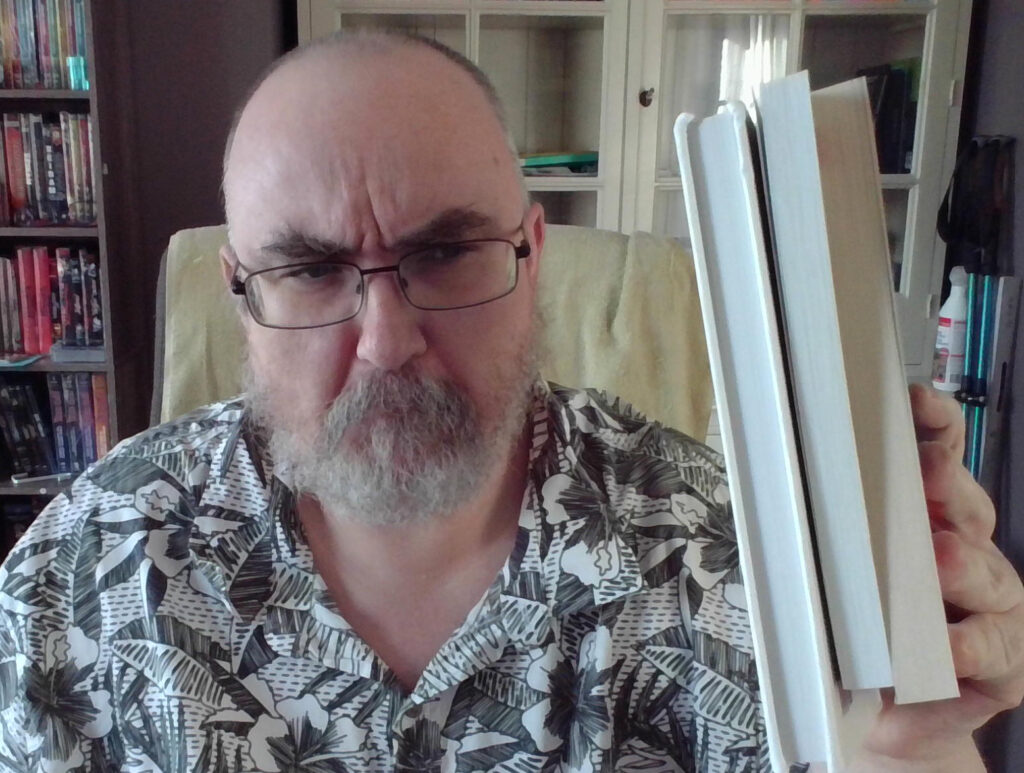
Books {held | stacked | pointed to} spine back while a thoughtful face is front and center and there’s a title like…
Five Books I Will Never Read Again Because They Are TOO Good
or
Three Books You Have Never Read but Should Get Right Now
or
These Books Absolutely Wrecked My Summer
The last one probably with fake tears added to the thumbnail, or some such.
And it is so annoying to be so constantly baited into every video where even if you know the BookTuber or subscribe or whatever you still have to essentially pretend to be tricked into watching it.
The new The Algorithm demands sacrifice. Tricks for Clicks! If you know what are you getting into, you might not waste so much time forming addiction to screens, amirite?! It’s that or absolutely low-tier enragement farming.
Look, we’re adults, here. Just show the books. Let me know.
If I have not read the books, then good! New stuff!
If I have read the books and hate them, then good, I can avoid it (or join in to see a difference in opinion).
If I have read the books and love them, then I can either avoid or watch to have my sense of utter-correctness validated. Win win!
Mostly, I suspect, the middle-of-the-road absolutely un-timeless, un-classics which proliferate across BookTube’s for-all-tastes vibe will bear little interest for me and that’s ok. I’m not here to yuck your yum, not really. I love that you love to read.
Let me choose to click or not.
Otherwise, I’m no longer clicking a goddamned thing. Well, except the hide channel and such.
I’m sorry the soul-sucking, orphan-crushing machine to which your livelihood is attached requires you to screech like performing monkeys and trick your audience to make it happy.
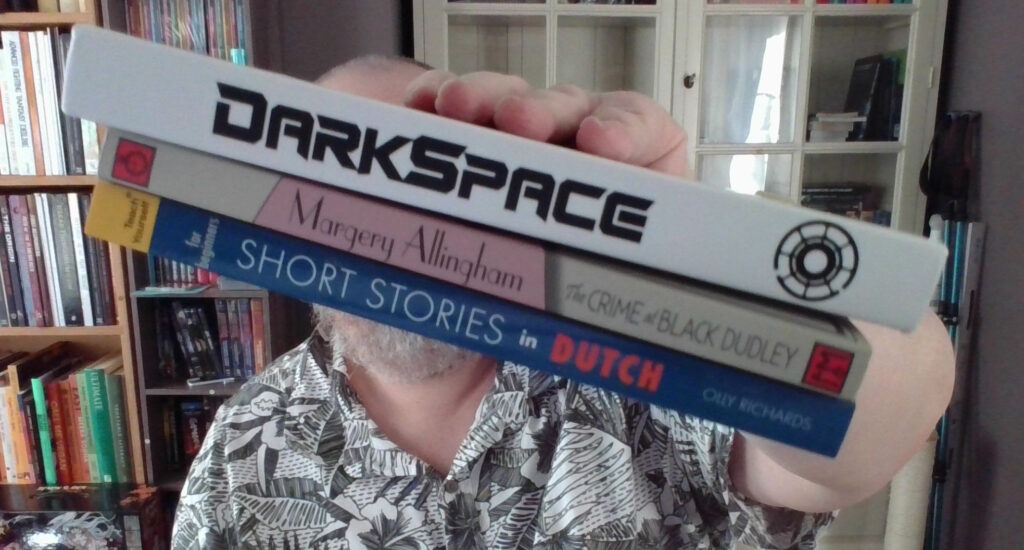
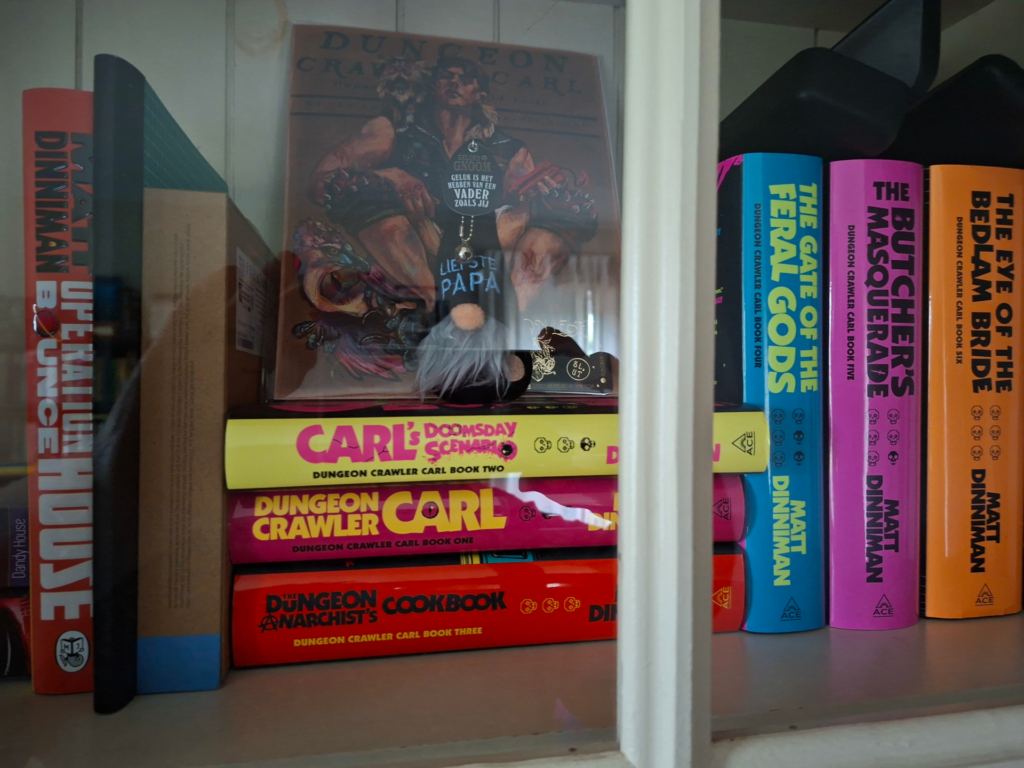
OH, here are the books, by the way. Lest hypocritical be I:
There’s no real reason for those three. They were just near my desk and I didn’t feel like spending longer taking the photo than typing the rant.
All three: recommended, if you are into that sort of thing.
Standard Ebooks is a volunteer-driven effort to produce a collection of high quality, carefully formatted, accessible, open source, and free public domain ebooks that meet or exceed the quality of commercially produced ebooks. The text and cover art in our ebooks are already believed to be in the U.S. public domain, and Standard Ebooks dedicates its own work to the public domain, thus releasing the entirety of each ebook file into the public domain. All the ebooks we produce are distributed free of cost and free of U.S. copyright restrictions.
There are other sources of pub-domain materials but Standard tries to standardize [hence, you know, the name] and modernize the layout. Having used just a small handful of their ebook versions, the difference is pretty noticeable. Some images and such put back properly. Text-corrections.
Sure, I could somewhat replicate using Calibre and tweaking a few settings to fix up some bits, but still: it’s nice to just be able to read a book without having to pre-edit it, first.
With the realization — from experience of formatting large amounts of text | information over my years as a web & marketing librarian — that such undertakings are hugely time intensive and involve a lot of people using a lot of scripts to download entire catalogs putting strain on a server: I went ahead and signed up for the Patrons Circle, today.
$15 a month and you get a few things like a better feed and a better access to collections. Can also suggest books. I won’t really use any of that.
This is just my general thanks.
The public domain — and stuff like CC-0 — are vital and important. They also require people like the folks at Standard Ebooks to actually provide the media to others. What’s more, I like the way that Standard Ebooks does it.
Recommended. The using of them, not necessarily the donation. Unless you end up really liking them, too.
EDIT: Forgot to add when I first clicked post, bonus points for not requiring me to go through something like Patreon to do this. They do use a third-party system to collection donations but the benefits themselves are currently directly from the site. I appreciate that. We need to de-Third-Party our internet, Space Pilgrims.
Last week, a growing pain in the right ankle/calf divide grew increasingly until now, when I am taking pretty much a full on breather from the whole moving thing.
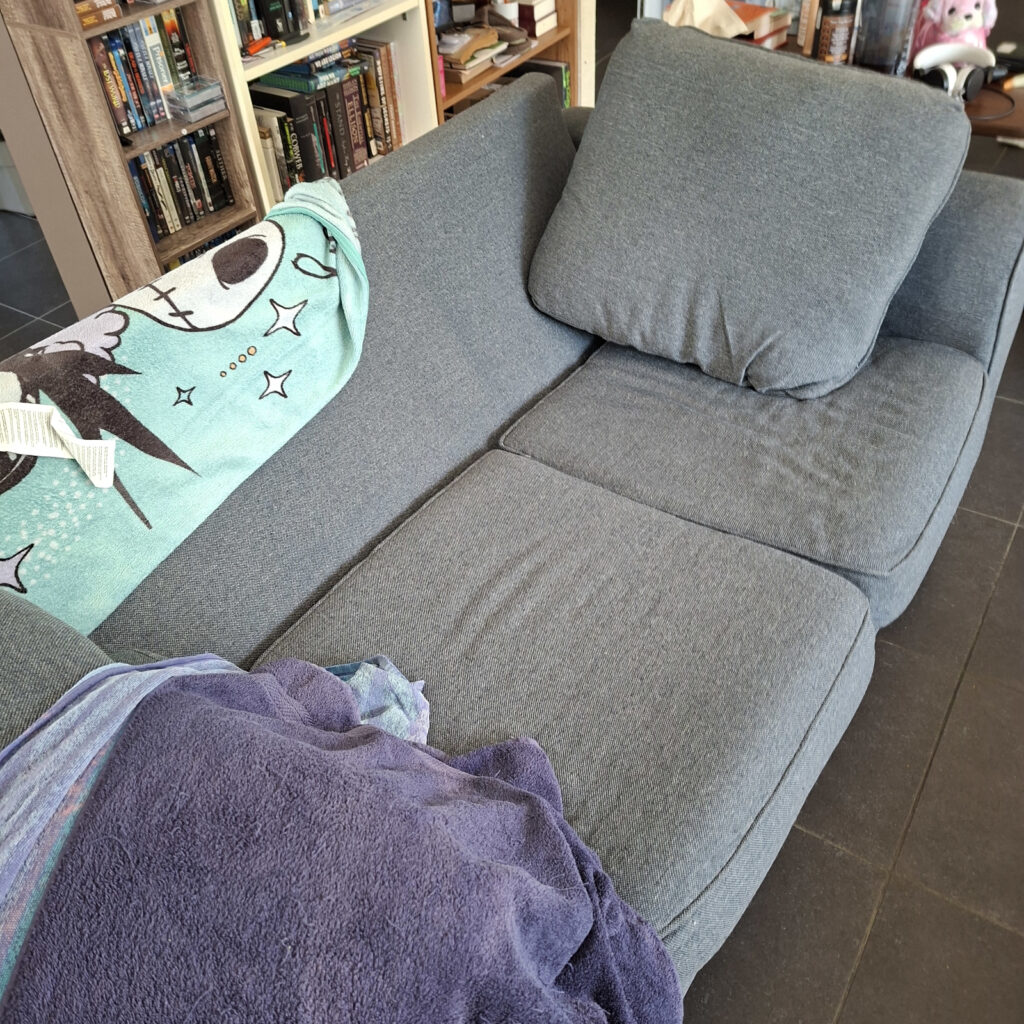
This is by way of introducing my “Avoiding | Reducing Chronic Pain All-Day Resting Nest of a Couch”:
You can see the expert skill of repurposing the back cushions into a resting place for my head and elevated legs. Kind of thing you don’t learn in those fancy-pants colleges and whathaveyou.
Ah, good times. Great times.
On the other hand, I have already finished off two books today and starting a third, so there is that. I’m just going stir crazy enough that I’m going to put aside the “all day rest” for a portion of the day and do a very, very slow stationary bike workout. Something like the equivalent of just floating on your back and letting the wind take you across the lake while you paddle here or there to stop from slamming into gators.
“Don’t float on your back so long you drift into gators,” isn’t, but feels like it could be, a proper Alabama saying.
Bonus sad times: my favorite black jacket which I have worn for…nearly (?) twenty-years finally had its zipper break. It was obvious that it was starting to break down but still…
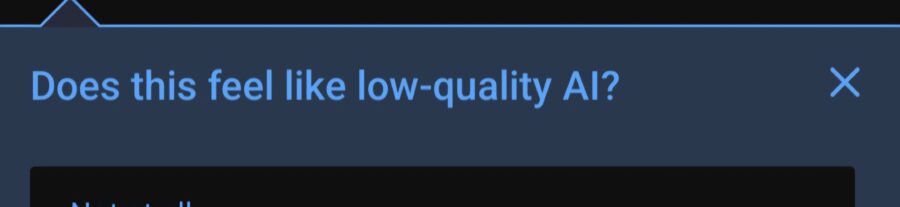
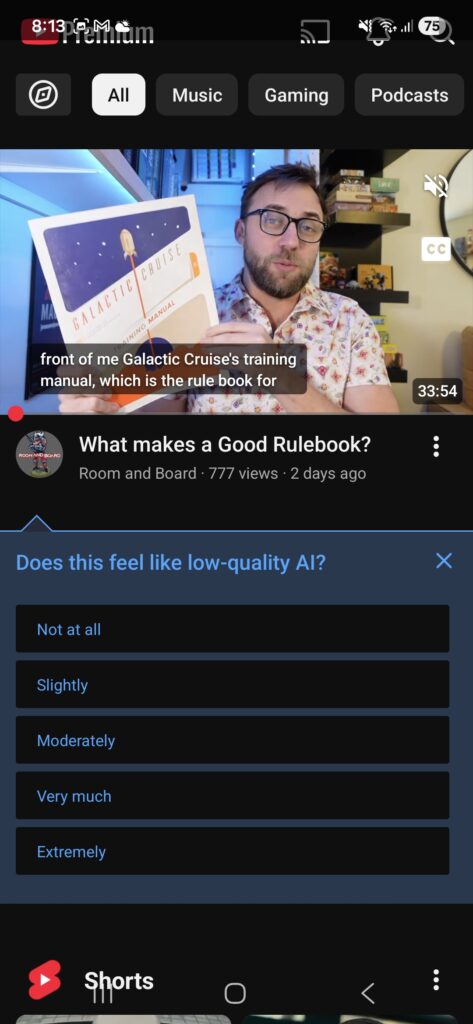
I got the above prompt while scrolling YouTube on my phone — bit laid up in bed due heavily inflamed right leg — and it’s the first time I have seen such.
Does this video feel like low-quality AI? Then results from not-at-all to extremely-likely.
Which makes me wonder if I’m being manipulated.
I do often tell YouTube not to recommend videos and channels that are obvious AI. Not always. Just in principle. YouTube’s floodgate recommendation system requires that. Watch one AI fake trailer and you will never know which movies are actually being released ever again.
Alerting me to the concept of AIness while promoting a 35min video about boardgame rulebooks from a creator I’ve never watched before, though? It feels weirdly manipulative…
(a) …like a little seed of doubt about what is or isn’t AI.
(b) …like a prompt to get me to watch a boardgame video after generally ignoring them for the past couple of years.
I watch a lot of solo rpg stuff, and I think this convinces YouTube, incorrectly, that I want broader tabletop slop in as addictive a manner as possible. Way too much D&D drama whinging and far too much boardgame critical theory about edge cases.
Because of that prompt, I was tricked into watching 5 minutes of a video I would have outright skipped, otherwise.
in the foggy maw of spring fall breath rises up all clove smoke like kraai kraait like yesterday met its gray road gray sky gray stems gray
over broken fields await be low awash all calico winds and creeping feline shouting the scent of dying grass and living soil while wisteria, stuk voor stuk, is parsed purple upon the ground
and roses strive new branches new thorns and out there, somewhere a child by laughing unseen calls up the grammar of bicycles and saturdays
Background and Writing
It’s a quick poem that came to me more or less all at once so unlike nearly every other poem I have contemplated since restarting my blog, I was able to get it down without any significant loss between thought and pen.
It is a quite literal poem of this morning. It was gray and foggy and felt extremely autumnal with fields cut low and crows cawing and a general late-year grayness about BUT there are also children riding bicycles and shouting and purple wisteria blooms.
There was an experimental aspect to it, though, which I want to document.
First, Fast Draft
The creation was a bit unique and not necessarily something I will use often but I wrote the poem, initially, like this:
in the foggy maw of spring autumnal breath rises up like clove smoke like crow caw like yesterday gray road gray sky gray voices
over shorn fields waiting all calico and cat like in the smell of grass shout
while wisteria, one by one, purples down into the ground
and roses rise up to the occassion of new branches and thorns and
somewhere a kid shouts bicycles and saturdays
Line by Line Machine Translation
Then, I fed line by line into Google Translate, including all the broken lines and misspelled words, and asked it to translate them into Dutch, and got this:
in de mistige muil van de lente De herfstgeur stijgt op als kruidnagelrook zoals kraai kraait zoals gisteren, grijze weg, grijze lucht, grijs stemmen
over geschoren velden wachtend allemaal lapjeskatoen en katachtig in de geur van gras schreeuwen terwijl de blauweregen1, stuk voor stuk, paars kleurt de grond in
en rozen komen tot hun recht in de gelegenheid nieuwe vestigingen en doornen en Ergens roept een kind: fietsen! en zaterdagen
Putting Back to English
Then I had Google Translate translate the whole thing back into English, and got this:
in the misty maw of lente The autumn scent rises like clove smoke like a crow crows like yesterday, grey road, grey sky, grey voices
over mown fields waiting all patchwork cotton and feline screaming in the scent of grass while the wisteria, piece by piece, turns purple into the ground
and roses come into their own in the opportunity new establishments and thorns and Somewhere a child calls: cycling! and Saturdays
Finally, Dougifying It
Then I took all three versions and blended them together and edited them in various ways. In a couple of places, leaving the Dutch obvious such as “kraai kraait” and “stuk voor stuk.”
In others, though, I teased out Dutch >> English puns. Paars is Dutch for “purple” so the wisteria is “parsed purple” and “met” is likewise for “with” so “yesterday met its gray road” is technically “with its gray road”.
“Stemmen” = “voices” so that became gray stems instead of gray voices.
Then, I went through and added a second draft of “Doug-ness” to it. “Shouts bicycles” became “the memory of bicycles” to make it more obvious and then “the grammar of bicycles” to make it more Doug-like. A few other similar tweaks occurred.
It has been a LONG time since I have tried writing a poem to completion, so I’ll likely need a bit of practice but there you go.
It might be a false connection, but I love that the Dutch word for wisteria is “blauweregen” which, broken up into “blauwe” and “regen,” would mean “blue rain.” ↩︎
A fairly long habit of the older version of Dickens of a Blog was to have a reading tally where I personally tracked the books I read.
It started with “The Winter of Reading Lots” which was actually from September through December. The challenge, then, was to read 20 books and I seem to have hit it. To keep it “fair,” I introduced a weight, initially, so that different books had different points based on length and format. The data of the original weight is somewhat lost since I did not keep a changelog once I completed the challenge and just kept it as a rough tally.
Then, in 2007 I started the true precursor to the weighted reading tally. I will warn you, this is back when I read in the range of 70-120 books per year. 2007 was the first year where I actually started to properly try and break it down to get a better sense of what fit where in the reading spectrum based on my own vibes about the reading material.
In 2008 I started to develop the formulae to weight it towards a normalized book. Books were 1-2 books per book. That’s all you need to know to get where the madness might lead. The end result was 117 books.
By 2015, the last year it was kept as such, the formulae had developed to have a few different content types/lengths and had developed into what I felt was a pretty accurate reflection of my reading speeds and such. However, my reading habits were plummeting and I was only updating the notes semi-frequently so no doubt numerous things were getting lost.
Note that 2013 was incomplete and 2014 is effectively non-extant (presumably lost to some website update/glitch).
After almost a decade of rough years, really good years that involved a new kid, COVID, a life-changing accident, and all sorts of things I am finally wanting to try and get back into the “Reading as sport as well as pleasure” mindset and so today I spent a couple of hours building a brand-spanking new weighted reading tally and then converting my Have-Read List 2026 into that format. This now includes slightly different math on Short Stories and Graphic Novels and introduces Light Novels.
The new math/weights helps different divisions to add up more consistently (the old math meant it would count as reading “more” to list each comic/story in a graphic novel collection separately, for instance, now it is closer to a 1:1 for most).
But, Why?
There are a few reasons why I like doing this:
This is the kind thing that librarians who work with metadata and build web-pages consider fun, frankly.
Bragging.
I like having the data for myself because sometimes I forget exactly which volumes I read, and when, and having at least a basic finding tool helps me remember “Oh, I was on volume 7!”
A lot of systems that track reading lists tend to weight everything as 1 so you end up with a manga volume counting the same as War and Peace and that does not feel right.
It’s frankly a bit of a tragedy that readers who track this sort of thing are some of the most susceptible — besides people tracking their fitness/diet — to requiring third part data scrapers to enumerate their good habits.
Several of the more prominent ones are either baked into an eco-system — such as Amazon/Goodreads — or require at least as much time to add it to an external system and it would take and this way I can control the data.
The big reasons are mostly that I like external memory devices and it’s fun to brag, but I want to brag with a veneer of math.
I got a text from UPS this evening that required me to click enough things that I was slightly convinced it was a scam for the longest time.
Turns out that a book I ordered through Kickstarter — at this point I am not naming-and-shaming because I’m going to assume honest mistake or software glitch — was shipped into Belgium with a reported value of $0.01.
Just in case someone was trying to outsmart the system, here’s a bonus fact for you: Customs officials aren’t stupid.
No one is spending $10-$20 + $10-20 in what should have been submitted as VAT charges just for a $0.01 item.
And that’s the story of how I had to use my phone to try and edit a screenshot of the reward and likely pay a +€20 customs up-charge1 because no way they actually paid the VAT if they declared it for a penny [if they did, they drastically underpaid].
Anyhow, we’ll see what the next step is.
I’ll let the person who came up with the project know the exact specifics, no doubt.
To clarify, I’ll have to pay the VAT on the book and THEN a €20 processing fee, which together will likely come close to equaling the cost of the book once you factor in the shipping I already paid. ↩︎
Tuesday night, I was watching through one of my absolutely all time favorite comfort watches: “Sweet Danger,” a double episode of BBC’s Campion.
Amanda Fitton and Albert Campion’s flirting remains dear to my heart years after first watching. Dawwww.1 Series needs a dang Blu-Ray.
As I do, I got curious about seeing which of the Campion ebooks I have managed to accumulate — I have a complete run of the print books back when Felony & Mayhem had the license to print the print books — but…you know.
The First Oddity
What I found confused me, because while I wasn’t expecting to see the classic (to me) F&M covers, I was expecting to see the relatively profession covers of Open Road Media’s versions which have a certain panache. Instead, what I found was several variations of AI-generated content:
NOTE: This particular version doesn’t claim a publisher, as far as I can tell.
At least a solid handful of the books would still have the Open Road Media edition but would also have one of these newer versions priced lower so the “Albert Campion Series Page” is largely full of them. The general quality between the two covers is immediately obvious:
Open Road MediaAsimis
Now, AI book covers is not necessarily a truly-bad sign even if it is not necessarily ideal for hopes-getting-up, but I was also pretty confused (especially when care is not taken to capitalize “Albert” in the cover).
The Second Oddity
Allingham’s works are not, largely, in the public domain. Black Dudley2 is, and Mystery Mile. At least in the US (which Amazon dot com should be following).
Asimis is out of the Ukraine.3 They mostly cover the first four books so it is possible there is a different pub-dom situation there, or even a different licensing. Again, not sure how that impacts the American version of Amazon.com, but there you go.
There are two other publishers, though: “Unabridged Books” and “Adhyaya Books House LLP.” The latter is from India. Absolutely no clue about the first since it is effectively an impossible term to search with definite confidence. They bounce around in later volumes, here or there. Sometimes leading to copies with the completely wrong cover:
How does the “official” copy of a 200pp book get up to 5.2MB?
I have no idea the licensing, and so will assume this is all above board, but it does show how “manipulation” of prices can break Amazon’s Kindle listings when multiple versions of an ebook are available. Which can have some surprises for the end-user. Especially in the light of Amazon’s somewhat infamous 1984 incident back in 2009. [To this day, an incident taken majorly out of context by people who use to try and prove that Amazon is deleting books on the reg.]
NOTE: The Asimis books seem to be sub-licensed through De Marque who have a philosophy of accessible ebooks. Let me tell you how I know.
The Third Oddity (a two-fer)
In what is a perfectly Doug whoopsie, I accidentally fat fingered the “Buy Now with 1-Click” button while trying to simply scroll over to find out more about why there were multiple editions. That’s how I ended up with a copy of this book:
Goodbye $0.99, it’s like I barely knew you.
Right after mis-clicking, I let out a long sigh and then decided to look deeper to figure out more about what was happening. Here are some things I learned.
The Asimis illustrations seem to be taken from disparate sources. I do not mean to say that they are taken from various editions of Campion stories, they just seem to be either old images from other books or AI-generated images in an older, Victorian style. They “fit” the general shape of the passages to which they are attached, but also lead to a strange cognitive dissonance.
The Asimis text is different (with some typos/glitches but better reflow). I first noticed the missing quotes in the text at the start. To do some comparisons, I got my copy of the Felony & Mayhem paperback and went to the same chapter and had a little bonus surprise. The text was very slightly different. “Although you’re a foreigner, Squoire…” had no “Squoire” in the paperback. To check, I got the Open Road Media version of the ebook and checked it (yes, Space Pilgrims, thanks my misclick I now have multiple versions of the ebook on my Kindle…for accidental science!).
Not only does the Asimis have slightly different text with some additional words, in 70% of the cases it has better reflow with clearer paragraphs. Though, there are places where it breaks in other ways.
AsimisOpen Road Media
For those curious, in the print version it looks more like this in the Felony & Mayhem print book:
Open Road Media wins that fight, even if it’s paragraph spacing outside of it is lacking.
Here’s another change in text, though, where I like Asimis’s version:
AsimisOpen Road Media
I just like the “The name was a local one, derived” more than “The name was derived.” The former doesn’t really add anything but rhythm, and rhythm is important.
My guess is there is some difference between the American vs British text or some such, and that is causing it (Asimis using double-quotes in the American English standard).
The Fourth Oddities
Wrapping up, because this was more to document the strangeness rather than say anything particular [besides maybe Amazon should let you filter publishers more easily/readily and needs to control its dang Authority files…FRBR FRBR FRBR, amirite, ‘brarians?]
Here are two things I cannot confirm because I am not going to accidentally buy more copies of these books [please, fat fingers, please], but I saw two complaints while checking reviews that might be of importance:
(1) One reviewer of Mystery Mile said they were frustrated that it was simply a repackaged Black Dudley. The narratives of both are fairly different so my guess is that there is at least one version that gave one of the books the wrong title. I glanced through all the previews I could, but did not see it, but it could have been a paperback version. Or the reviewer might have been talking about broader themes.
(2) A reviewer of another “illustrated edition” said the the images were risqué. I have no idea their tolerance and have learned from experience that it could be anywhere from “lingerie” to full nudity.
Doug’s Final Thoughts
The primary final thoughts I have are, in order of importance to myself:
You should read more Campion. Yes, you. Allingham was delightful.
Campion needs a dang Blu-Ray+ edition.
I would 100% adore a Sweet Danger movie as long as they accepted the weird mish-mash of gangsters, evil businessmen, satanism, English folklore, “Local shops for local people,” and twee flirtations.
Amazon needs to figure out a way to keep this in control before it gets even worse when a billion versions of book can be insta-plagiarized by AI.
While not a long list at the best of times, the only on-screen flirtation that makes me giggle more is from The Mummy and that one is practically cheating because damn, son. ↩︎
Another publisher is listed as Andrii Ponomarenko, also from the Ukraine and also from Kyiv, with very similar covers across the books and very similar by-lines, so I assume this is the same person/entity. ↩︎
PLEX playlists are missing some sorting features — perhaps for good reason — that can be solved by creative abuse of song moods.
The Issue
Some of the issue is downright linguistic | intentional.
What is a playlist? For some people {0-100%}, a playlist is a curated, in-order list of songs they want to play. For some people {0-100%}, a playlist is a subsection of their musical library to help sort from years of backlog. For some people {0-100%}, a playlist is simply a large glob of music to played on random shuffle for long periods of time.
These groups can overlap where sometimes someone wants a big hunking random glob of music and sometimes wants to drill down to a specific artist in that glob and focus on that.
PLEX, though, seems to almost exclusively lean to the first definition for their playlists with the third being included by the shuffle command.
Which leads to an issue for the second definition.
Let’s say you build up a list of some of your current favorite songs [see image above for a few random picks]. Then, you think “Oh wait, I forgot this song by a particular artist” and you add another one…
Now that new song is there at the bottom. As you mouse over it [evidenced back in the top screenshot] you can click and drag it or delete it, but once a playlist gets over, say, 50+ songs the amount of time you can spend adding new tracks by an artist and sorting can get lengthy.
On MOBILE, it does allow you to “see” a playlist by albums and artists, but it puts those items in the order they first show-up rather than alphabetically and clicking on that item doesn’t take you to the songs in the playlist that match the criteria but to the whole album or artist:
This means that a playlist as it stands serves only the first and third categories: Specific Play Order and Random Glob. However, I really prefer the second and third categories mostly: Musical Subset and Random Glob.
I set out to see if I could figure out a workaround, and I sort of did.
Collections and Smart Playlists
Playlists are not the only other sorting method in PLEX. There are actually several (including stuff like Folders) but for now I’ll look at two: Collections and Smart Playlists.
Collections are applied on the Artist and Album level (but not song). They can be whatever you need. I keep several albums sorted in various collections for soundtracks to various solo play campaigns and a broad pair called “Spark Joy” — for something akin to “current hits” — and “Core” — more for major albums of my life.
Smart Playlists are as they seem: playlists generated “on the fly” based on certain criteria which match. Album genre, release date, artist country of origin, whatever.
For reasons I do not understand, Smart Playlists support better sorting.
For instance, I can create a Smart Playlist that only shows music released in 2026 and then sorts it by most played albums so my top played stuff is near the top. It’s a fairly trivial sort.
The problem with this is that Smart Playlists are looking for certain standard criteria. That DEMO playlist above is lacking any obvious structure that would make a good Smart Playlist. There’s several j-pop pieces and then a single song from Belgium.
How do we bridge that gap? This is where I realized I could “abuse” Moods to create something new.
Song Moods
Songs do not have “Collections” as part of their tags for whatever reason. They only have “Moods” and “Genres.” This is, perhaps, an oversight. However, this is all about hacking around limitations.
Let’s go back to the idea of a “Spark Joy” list for current hits. I can add a “Mood” to a song I want to be in my Spark Joy list. I can call it what I want, but for now I’ll just call it Spark Joy (which I’ll apply to the recent “drop dead” by Olivia Rodrigo):
I can go through and add this Mood to every song I want to be on the playlist. Then generate a Smart Playlist based on the Spark Joy Mood, and get something like this:
A playlist that allows for types 2 and 3, which is good for me.
It also allows me to build “anti-moods” [I use zzzKEYWORD to make it easy to find] to exclude songs from being played from Smart Playlists generated from wider criteria (e.g., country of origin). Why? Think of things where you have a genre or decade or whatever but in the middle of that is a “Best Of” or “Live” album that you don’t want to have play. You can set up something complicated like this:
Essentially, if it matches any of those genres but does NOT have the track mood “zzzJapanese” then it will show up. It can also be useful I want to tag a bunch of albums has having something like “Epic” mood but there are a few songs that break immersion, that sort of thing.
Type 1 Playlists Require Actual PLEX Playlists
With that being said, if you want the type 1 playlist — Specific Play Order — this will not work. For those, you would use the actual PLEX playlists.
Far From Perfect
All this being said, this is far from perfect and it is not a slam-dunk solution. I like it, because it allows me to do metadata sorting. It fits my mindset as a librarian. Still, there are issues. Some might be killers for you.
(1) [SMART ]PLAYLISTS DO NOT HAVE QUICK SONG EDITS
If you are in the album view, etc, you have a little pencil icon you can click on to edit a song where you can adjust song mood and such. For some reason, this is hidden in the playlist view, including Smart Playlists. This means if you get to a song you no longer want to be in the playlist, you have to click on the song title, go to the album, and then click on the pencil icon there.
(2) NO SUPPORT ON MOBILE (?) YET (?)
I thought I read in release notes that PLEX was going to {soon | in beta | ???} support editing track/item metadata on mobile but right now it does not seem to exist, at least not on my build and app. This means if you use this system to build up sortable playlists, you have to use the Web interface while you can use the more traditional playlists just fine in mobile.
(3) UNSURE: MIGHT NOT WORK ON SHARED
This one I don’t know, but it possibly won’t allow folks whom you share your library with to build their own similar set-ups. I’ll have to test this one and get back to you (Kaz has been wanting access, so they can be the guinea pig).
(4) TIME CONSUMING
The biggest problem is that it takes a fair amount of time to start. After you get early parts in place, adding a few songs is relatively trivial but the initial building of the Mood, Anti-Mood, and Smart Playlist is potentially a longish investment.
Compared to the time it would it to take you to do something similar in Foobar2000 it is pretty extensive. I assume Spotify can do it pretty quickly.
STILL, something like PLEX gives you control over your own music in many ways, while retaining the ability to play it across multiple devices or on the go.