I’m going to not wade into the fact that you are almost definitely hearing about post-partum depression a lot because it is a mid-term election year in the United States (though you most likely are). In 2024, there was a certain track meet. 2020 I don’t even have to talk about.
Let’s just say certain patterns persist.
The less emotionally draining side of this same conspiratorial coin — though frustrations do run deep — is people trying their absolutely hardest to Both Sides™ the UN’s adoption of Equal Earth Projection maps.
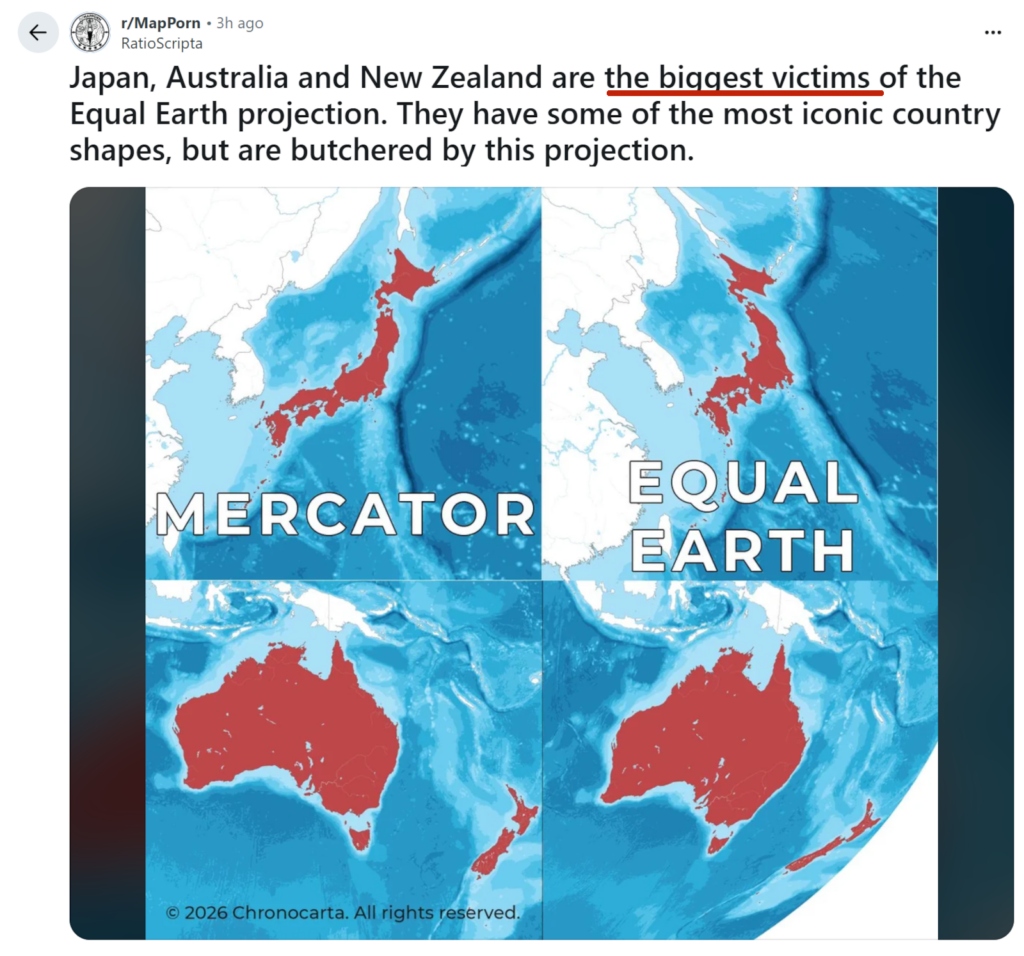
Just today, this post popped up like so many others on Reddit as of late…
Obviously, I highlighted the text to bend it to my argument but the fact that the poster [whose name I kept in if you want to look some of their stuff, which does include some quite interesting map discussions besides this] felt to describe this in terms of victimhood just shows how people are baking the argument into the pretense of a statement. Begging the question or some such legal term. The mind boggles. Et cetera.
“Biggest victims…” Lord save us from Redditors. Could have just said something like “have the largest distortions in Atlantic centric versions of the maps” or whatever.
I legit feel that certain algorithmic forces are trying to poke this bear and ride the US-defaultism nature of sites like Reddit, Youtube, Facebook, etc to try and convince you that you should feel victimized by a map. Maybe I am just really unlucky. Who knows.
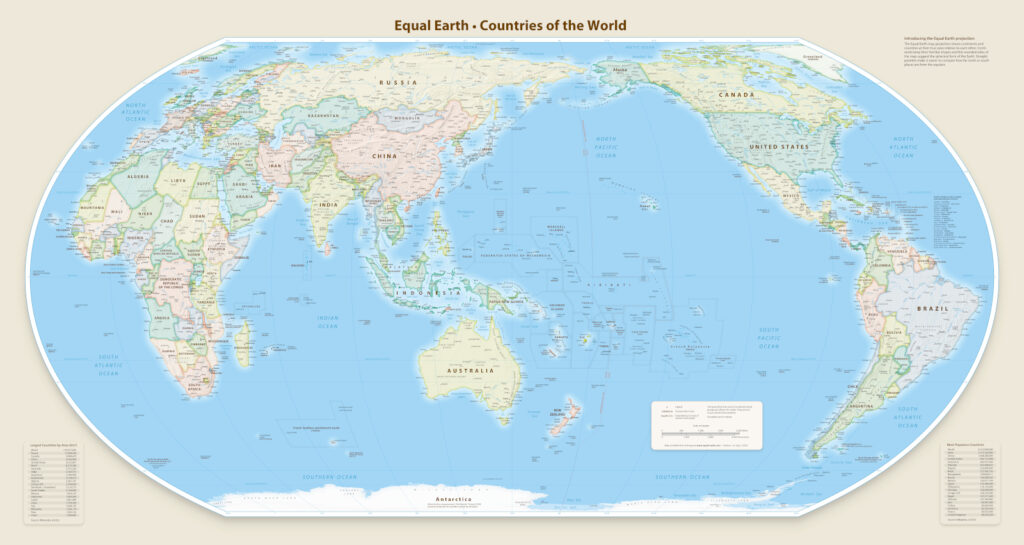
OP is also just wrong. Here’s what the above would look like if they had used the Pacific centered version of the map (which honestly gets more landmasses right so I don’t mind it, even as an Euro-located person, sorry Greenland/Iceland).
Heck, several places already use projections that are closer to to Equal Earth than Mercator. Go look at stuff like Winkel Tripel and Robinson Projections.
Good for all the people learning this past week that not everyone uses the same Atlantic-centered Mercator map (even if they end up preferring what they know). It is a nice moment to find out how other people do such things.
For the record, my favorite is probably something like Dymaxion or Hao’s Projection. Pole focused maps make the various landmasses much more interesting to me.
Also, we are now in the era where digital maps and the ability to have multiple projections at once makes this very, very moot. Different maps for different tasks.
Have you ever been bothered by something which might not exist but also probably does? Something that is out there, perhaps intangibly, but its inchoate presence is felt like a fear more than actually touched?
An asteroid drifting through space an AU away. Undoubtedly there, but maybe just never here?
I have a similar feel to the collective responses and comments across online forums, social media, and more or less any place with open comments.
This post is directly in response to a couple of crowdfunding campaigns I backed early last year which have this year run into delays largely due to variances in the whole global shipping market (especially for smaller creators). A fair percentage of the comments are relatively positive or positively constructive, maybe asking for a refund due to the delay.
Just, there are a lot that are oddly…passionate. I’m talking about, “This is your last warning, you will SEND ME MY BOOKS!,” type stuff. Sometimes across multiple paragraphs. This is the stuff publicly posted so I can only imagine the personal emails and such are worse. Saw a couple of exchanges where people went back a bit later to apologize for some of the things they said, but then there were newer comments where these delayed shippings were deeply emotional troubling to the commenter.
I get it, I really do, but delayed shipping due to 2025/2026 is not exactly a personal attack. Few things are. If there is one thing I need you to take away from this post, it is this:
The content creator most likely does not know you and despite the constant drive to content consumers towards parasocial relationships1, virtually (even absolutely) nothing the creators do is aimed at YOU personally. Fact is, one step towards happiness is realizing how few people actually even know you exist. Start with those people.
It is also just a broad response to why I can’t quite stand getting back into any social circle on the internet as a whole for long.
This is not a new phenomenon. “Don’t read the comments!,” has been internet wisdom longer than many current internet users have been alive. Back 10-20 years ago I had multiple scripts and style overrides in place to essentially hide every comment section on every site I regularly visited.
It just also feels worse. There’s a flavor there that I cannot fully place or identify. But it bothers me.
Years ago, maybe decades ago now, there was a comment/forum section for AL.com2 where posts were strangely deranged and strangely off-topic. A collection of ego-centric diatribes in which virtually any topic was an assault on their particular self and way of life. Museum having a new exhibition? Dozens of rants about how art erodes the community while eating up valuable taxpayer dollars and also their nephew saw a painting of a fish that was aesthetically unpleasing. Which might turn into a debate about best fishing spots and how BamaKid033 is mentally broken if he likes fishing on X River. New fried chicken restaurant? THEY are destroying property values in good Christian neighborhoods. Space and Rocket Museum getting a grant to help preserve some of their exhibits? I kid you not, the end of all goodness as we know it. This last one happened a few times.
It has been some time since those were in existence so I am just taking some broad swipes but, Space Pilgrims, I need you to understand they are only gently broad. I just dialed them up a tiny bit for effect (and also dialed down for palatability).3 These were regular commenters. Racist. Deeply political (especially, on AL.com, to the right-wing side). Paranoid. Snarky. You can tell they thought they were funny when posting it. Starting from an immediate stance of aggression and personal attacks. Simultaneously painting the commenter as both the victim and also the powerhouse of the known universe. “You will listen to me! I am tired of being used!”
Maybe now that I’m largely off social media and largely in my own sphere doing IRL projects it feels worse than it is, but it feels to me like the AL.com comment section has taken over the internet.
OR, to use a different but similarly timed example, remember how Rebecca Black and her mom paid money to make a fun video where it was just a bunch of kids having a blast being in a music video? And the internet decided that because they could see it that the video was somehow forced on them and people, including somewhat reputable musical journalists, felt the stupid need to comment on it? To attack children for a video that should have been seen by a few dozen people and be a fun, core memory?
The hatred towards Rebecca Black’s “Friday” should be studied as one of the dumbest moments in internet history and a lesson we absolutely did not learn.
I really don’t think the human race has caught up to the fact that the internet is by and large voluntary. I’m not sure, at this point, if we ever will.
I saw a video this past week where a person who posts regular videos-of-the-day to talk about fun topics — in other words, using Youtube kind of like it was first and for a long time used — just was discussing an odd thing he read on Reddit and there were multiple comments where people were angry about the existence of the video. It felt like the presence of that video in their subscription feed was an affront to them.
Find any article that is slightly negative — about veganism, Doctor Who, whatever, pick a topic — and then people coming out to comment in a kind of hateful, snarky tone is not precisely unexpected. Studies have shown how people are drawn to negativity in social media and online discourse. It is just the vibe feels… well, it’s a vibe.
Paranoid. Self-obsessed. Angry. Lacking thoughtfulness. Lacking respect. Personally wronged. Gleefully antagonistic. Raging against the dying of the light (which might not ever have existed, another fake fall from Eden). Victim and aggressor. And, perhaps most annoyingly, utterly convinced that a slightly humorous, snarky tone is the exact way to make them sound sane. Why is it always posted in a faux-humorous tone? Did Vine and X break us? That short form commentary must be cute and funny? Hell if I know.
To put it in another way, it is like we have regressed as a digital society. Because we are on our phones on our own couch, maybe we think the internet has come to our living rooms rather than us going to it? A generation of people being fed by food delivery drivers complaining about the decor of restaurants. A generation waiting for the AI bubble to pop and spending hours each day creating AI art to pass the time out of fear of boredom.
“We drove to the gym…” only it’s everything, everywhere. All at once, even.
You blend this with rampant positivity on the “other side” and it is maddening. Of course both being couched in various oft-repeated phrases that have been The Algorithm™ approved. Generally without personality.
Four blue hearts in a line or death threats with nothing in between. Where “mid” and “average” are active insults.
“Ahh gurl energy got me feeling some way…,” fucking indeed.
THEN, Space Pilgrims, then we add in the bots…
Something made worse by platforms driving creators to fake friendships and engagements in order to court people towards things like Patreons and Youtube Memberships. It is deeply gross. ↩︎
I’m not linking it because I don’t really like their new website but it is awfulllly trivial to figure out how to get to it if you want to see it. ↩︎
I had a friend who hung out on that forum who got involved in a MULTI-year MULTI-party bullying cycle where many members claimed other people were stalking them or trying to destroy their lives. It was…odd. ↩︎
The new proposal would offer European users two choices: continue using free versions of Instagram and Facebook with personalized ads, or pay for ad-free subscriptions. The changes would not affect Meta app users in other countries, including the U.S.
Now, you could argue — if you are a sycophant who thinks giving billionaires your personal data is a fair deal just so you can continue to doom-scroll instead of taking up useful hobbies and getting more sleep — that giving up personal data for “advertisements” is easy. And free.
Got to love it when Meta tells its users that their data is worth €5.99 – €7.99 [I’ve seen two different values, quoted] per month. That much, huh?
Sounds like a great backbone for a really big lawsuit to recoup all the stolen value from content creator’s hard work currently being funneled into AI-training machines.
Ok, that’s a lie. A lot of things about “BookTube” drive me a bit mad. Most of it, really. There is good stuff, real good stuff, but I rarely care to watch enough to find the good stuff.
I’ll be in a mood to discuss more later, maybe, but here’s something from dozens of thumbnails that is now irritating me enough I’m going to start telling Youtube to not recommend me channels which use it:
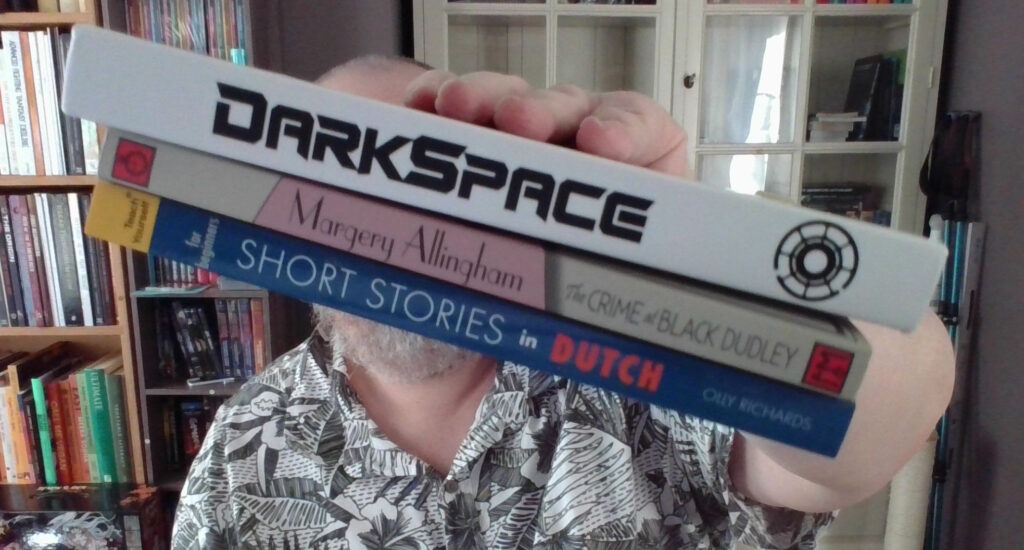
Books {held | stacked | pointed to} spine back while a thoughtful face is front and center and there’s a title like…
Five Books I Will Never Read Again Because They Are TOO Good
or
Three Books You Have Never Read but Should Get Right Now
or
These Books Absolutely Wrecked My Summer
The last one probably with fake tears added to the thumbnail, or some such.
And it is so annoying to be so constantly baited into every video where even if you know the BookTuber or subscribe or whatever you still have to essentially pretend to be tricked into watching it.
The new The Algorithm demands sacrifice. Tricks for Clicks! If you know what are you getting into, you might not waste so much time forming addiction to screens, amirite?! It’s that or absolutely low-tier enragement farming.
Look, we’re adults, here. Just show the books. Let me know.
If I have not read the books, then good! New stuff!
If I have read the books and hate them, then good, I can avoid it (or join in to see a difference in opinion).
If I have read the books and love them, then I can either avoid or watch to have my sense of utter-correctness validated. Win win!
Mostly, I suspect, the middle-of-the-road absolutely un-timeless, un-classics which proliferate across BookTube’s for-all-tastes vibe will bear little interest for me and that’s ok. I’m not here to yuck your yum, not really. I love that you love to read.
Let me choose to click or not.
Otherwise, I’m no longer clicking a goddamned thing. Well, except the hide channel and such.
I’m sorry the soul-sucking, orphan-crushing machine to which your livelihood is attached requires you to screech like performing monkeys and trick your audience to make it happy.
OH, here are the books, by the way. Lest hypocritical be I:
There’s no real reason for those three. They were just near my desk and I didn’t feel like spending longer taking the photo than typing the rant.
All three: recommended, if you are into that sort of thing.
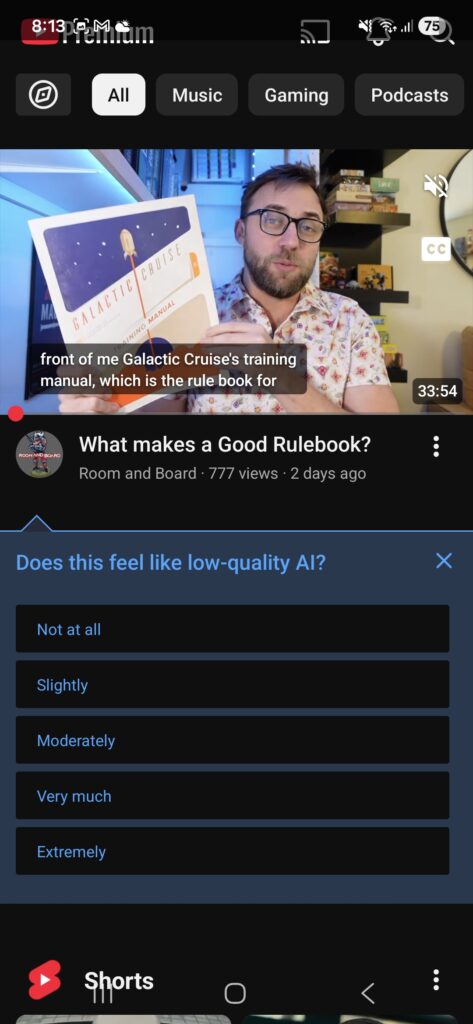
I got the above prompt while scrolling YouTube on my phone — bit laid up in bed due heavily inflamed right leg — and it’s the first time I have seen such.
Does this video feel like low-quality AI? Then results from not-at-all to extremely-likely.
Which makes me wonder if I’m being manipulated.
I do often tell YouTube not to recommend videos and channels that are obvious AI. Not always. Just in principle. YouTube’s floodgate recommendation system requires that. Watch one AI fake trailer and you will never know which movies are actually being released ever again.
Alerting me to the concept of AIness while promoting a 35min video about boardgame rulebooks from a creator I’ve never watched before, though? It feels weirdly manipulative…
(a) …like a little seed of doubt about what is or isn’t AI.
(b) …like a prompt to get me to watch a boardgame video after generally ignoring them for the past couple of years.
I watch a lot of solo rpg stuff, and I think this convinces YouTube, incorrectly, that I want broader tabletop slop in as addictive a manner as possible. Way too much D&D drama whinging and far too much boardgame critical theory about edge cases.
Because of that prompt, I was tricked into watching 5 minutes of a video I would have outright skipped, otherwise.
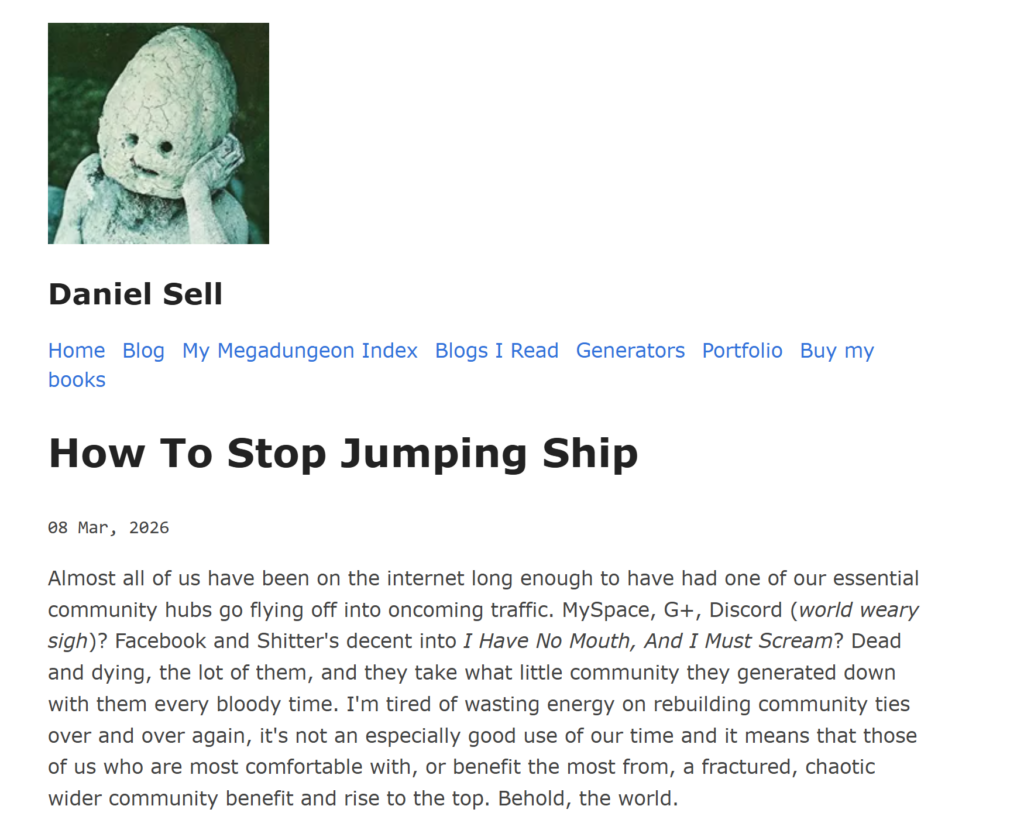
It wasn’t technicallyDaniel Sell’s “How to Stop Jumping Ship” that made me start thinking about the topic of this post, but that is a linkable resource that has some of the information that has filtered into my brain space:
Important bit from slightly below that:
So I propose…we just toss it all in the bin and go back to the beginning. Blogs, newsletters, IRC, mailing groups, and, sure why not, Usenet, go nuts…These things are time tested, functional even in the face of overwhelming lack of interest from the general internet, and are, most importantly, utterly unbreakable. A specific blog, irc etc etc might disappear, but that won’t take anything besides that one facet of a larger whole with it.
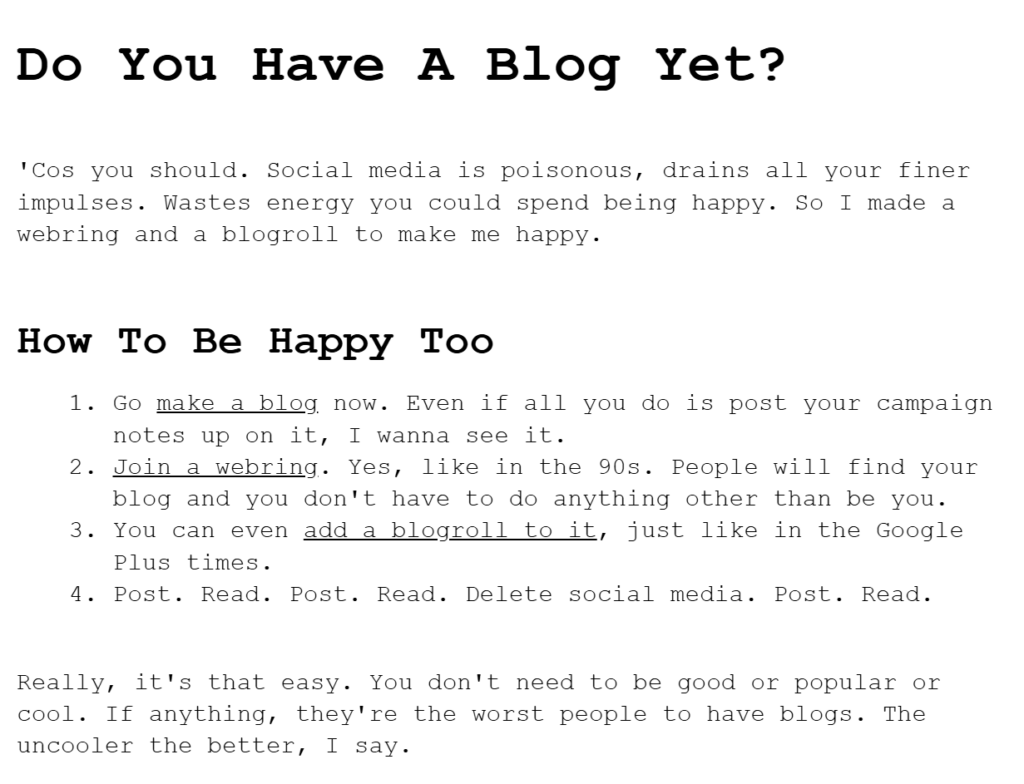
What actually started it was an email which was sent out to the Melsonia email list. Same sort of information, a bit more pithy:
Pretty much everything in that image is in the above linked post, though one addition is very much in-line with the stuff I talk about here, which I’ll quote:
Social media is poisonous, drains all your finer impulses. Wastes energy you could spend being happy.
He includes a link to Bear Blog which I won’t include because I’m sure it is fine but this is not an endorsement of a particular product over the other and at a glance, the software seems to violate a couple of principles I’ll talk about in a minute.
If anything, this post is absolutely an anti-endorsement of anything that might be considered a product. Websites/Apps-as-products are killing us. Killing the earth. Killing creativity.
I Digress All Over The Algorithm
One caveat creeps up almost immediately: Sells and I are at least partially concerned about two different things. He seems to be largely talking about (a) moving towards a platform where ideas exist outside The Platform® and are not beholden to the constant drive towards enshittification and profits AND (b) coming up with something that trumps the Algorithm Class’s version of a good time. I like both of those things, both fit strongly in my Reclaim Ownership concept I have been discussing here or there on the blog, but I think for me there is something else brewing in my brain:
Stop treating the Algorithm Class like your friend: you are a commodity to them and the current internet is designed to take resources from you and feed your resources into their bank accounts [money they use to take more freedoms from you].
We are witnessing the death of ownership and are being manipulated into thinking we need them. In 2026, The Algorithm tells you you are bored, that you are unhappy, that you are worthless without The Algorithm, that your replacement worth is derived from the dopamine you get from participating in a rich-person’s profit margin. And we believe it…
Come and share! Like and subscribe! Upvote! Get your five-year streak!
We live in a world where we give third-party companies all the content that makes the platform worthwhile but then you give up increasing rights to your own creations as they rapidly change the rules. They don’t even ask nicely. They just have your college friends’ content being held hostage and you are lonely.
AI amoebae demanding access to our creations. Less control over what we can share versus keep. Free-fall user unfriendly design based around selling digital baubles. Digitally engineered loneliness and disease. All the other terrible aspects forced upon you while specialists in behavioral modeling outsource whitepapers to tell the owners of the servers how to maximize profits from your work.
It’s Big Tobacco all over again. Paying experts to make things more addicting while telling us they are just giving us a product we really want and rumors of your own addiction are greatly exaggerated.
With the bonus that it’s not only our creations, but often the core of our friends and family groups being held for ransom. “Keep smoking and you can keep talking to your mom back home!”
THEN, they take extra data from you and sell it.
It’s like the worst possible version of the peer-review process. That process has volunteer writers being edited/scored by volunteer editors and volunteer peer-review committees. Then the output is given freely to scientific publishers who generate substantial profit off making it available. With the consequence of not publishing can include missing out on tenure and promotion.
Only instead of contributing to the ever-expanding world of valuable science, we are simply trapped in a loop where in leaving a billion-dollar money maker we have no control over ends up with being branded as anti-social and distant. No party invites without social media. Missing out on collector’s items by our favorite brands because people on X got first dibs. How in the hell do we know what Florida Man is doing this week unless we spend hours each week doomscrolling through made up posts about Florida Man?
“I can’t leave Instagram, what about all my friends!?,” we say over and over as our data is stolen and the money generated from it is spent to lobby for war crimes. Taking your joy of expression and turning into AI slop generated in data centers so environmentally unfriendly they are altering ecosystems while unwriting decades of copyright and intellectual property law.
Don’t say, “If you are not paying for it, you are not the customer.” That’s tired. Sad. Ignorant. You can pay for it all day long and to The Algorithm Class you are just money and never enough.
Besides, you are very much paying for it and its the most expensive purchase you have ever made.
Like cats, there is no free social media. We are collectively paying billions of dollars to avoid going to bed on time. Our tax money spent to subsidize The Algorithm Class. In return, The Algorithm Class buying out a large portion of our governments for their needs. Every lost ecosystem and plot of land to build data centers. We are spending generational wealth indirectly to look at ads on Facebook.
And the saddest thing is that for all this money, you and your creations are worthless to them individually. Sold for pennies. A penny today so they can buy congressfolk to not pass privacy laws and make a dollar tomorrow.
That’s the thanks you get. Being sold for $0.03 on loop with no protections just so hackers can get your national ID numbers and ruin your credit while the data hoarders say, “oops,” and face no consequences.
There is no ceiling that will stop folks from generating profit off of your hard work and there are very few protections to keep you from suffering the laziness of their vibe-coding neglect.
I DIGRESS.
An Early Thought Experiment Towards Doug’s Ideal Web-Sphere
The point is that reading Sells’ post made me think about how hard it would be for me to actually get any of my friends and family on board with creating a web-ring or similar. I could probably get two or three signed up but the siren call of the wide-open for-sale web would hang there. We are two decades into the social-media-and-search-engine revolution that has stripped us of a properly free internet.
This means this is all in the heady realms of though experiment, so taking that as an act of freedom rather than problem, I was thinking of things I would like to see if I could back and shove Myspace off a cliff.
An actual emphasis on creator ownership, not just virtue signaling. No caveats or catch-EULAs where you give up the rights.
An emphasis on self-hosting or hosting done by entities where you pay them real world money to host your data and in exchange they treat it as hands off for any other use unless they pay you to use your data.
Related to above, but you are free to take your data whenever and wherever you please. Zero retention in a third party and absolutely no “a third party sold your stuff to another third party that has no contract with you explicitly” unlike the current real world problem.
“Censorship” and moderation are generated at the hands of the end-user through tools easy to read and use.
No advertisements unless the content creator is getting paid a substantial portion of the fee [let’s say 80+%] and at their behest [yes, this means content creators will have to pay to post stuff].
Multiple media streams — text, microblogging, video, audio — can be handled by servers optimal to them, each chosen by the content creator.
No addiction-behavior models. Discovery layer predicated by the needs and desires of the end user rather by a creation of any sort of presumed force.
In fact, there would be optimally many many end-user tools that have their own approach to discovery and moderation.
Anonymity vs ID exposure decided by content creators.
Absolutely NO Upvotes and, perhaps most controversial, probably NO comments posted to your own data stream [they would be posted to the commenter’s data stream]. The idea is to break apart the Skinner Box variation of the internet [as described here or there by Cory Doctorow]. You will not get algorithmically friendly shiny cookies. You share data and information and art: others can read it and watch it and enjoy it. SEO is the mind killer. SEO will pass right through you. When SEO is gone, all that remains will be memes.
In other words, something where people create content streams through many different self- or creator-focused-hosted methods and something — webrings, RSS/Atom feeds, metadata chunkers, your own eyes and fingers — will handle this and there will be no fake digital commons generating billions of dollars in revenue as long as you keep playing ball and getting your grandma to sign up for an account.
No lectures from AI-generated moderators about how you need to tweak your content to maximize conversions.
Hell, there would be no conversions. Death to the trust-economy. No product of The Algorithm Class has earned the right to addict us and constrain us to the information/data/consumption-complex they have chosen.
You decide what you want to read and no one knows what you do with it but you.
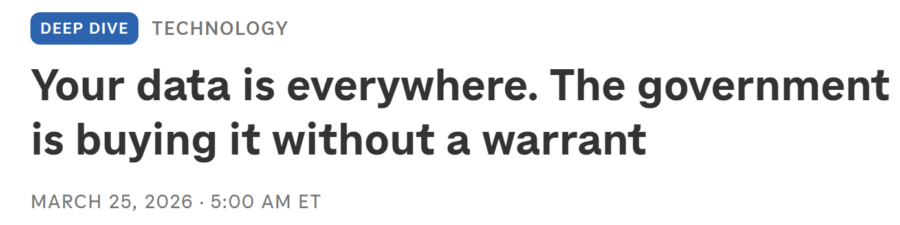
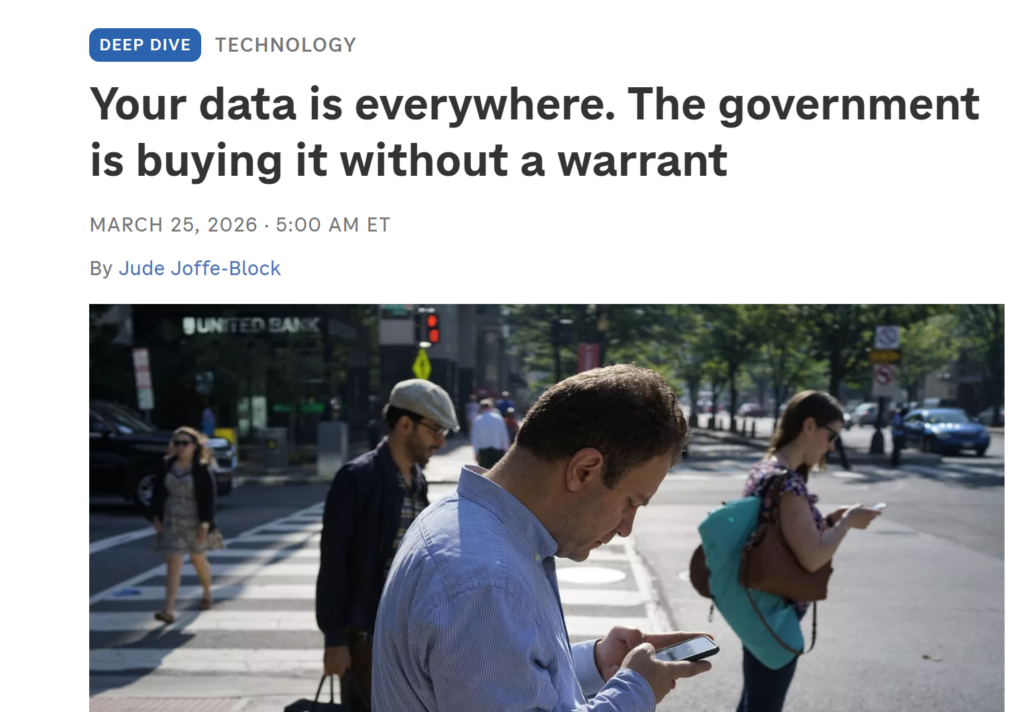
A whole industry of data brokers buys up vast quantities of electronic information from cell phone apps and web browsers and sells it to advertisers who use that data to target ads. The same industry also sells that data, including bulk cell phone location data, to police departments and federal government agencies in ways that can reveal intimate details about Americans without a warrant.
Now, privacy advocates say that the best chance for Congress to close the well-known loophole around the Fourth Amendment that allows for that sort of governmental snooping is coming up in just a few weeks.
That’s when Congress is expected to take up reauthorization of what is known as Section 702 of the Foreign Intelligence Surveillance Act, which is set to expire on April 20.
After a 2015 change to the law, federal agencies are not supposed to collect data on U.S. citizens in bulk. But some found a workaround to requesting warrants by simply buying the data instead.
I’m actually neither shocked nor awed. Pikachu face can stay in the desk drawer. There are funnier uses for the meme. This is why I get so frustrated by conspiracy theorists. The real world changing conspiracies tend to happen in the open but are discredited by the same media and enterprises complicit in their existence [but not, you know, actually hidden].
Best bit is that AI-companies owned by the Algorithm Class is the real clear winner, here. They get paid to digest the human experience en masse to better train their LLMs by selling the data to entities that treat this data as different from protected data despite being the same data.
I have no precise takeaway here or anything to add besides to say that if our data is worth billions to someone, it should be worth [collectively] billions to us. The same way that if information wins war then information should be considered protected by the second amendment.
We’ve entered into a strange new horizon where companies revel in increasing the cost of doing business with them by, with very little choice, forcing a lot of us to give up vital aspects of our own liberty [namely the ownership of our own identity].
“If you are not paying for it, you are not the customer,” is dead, long live:
“You are now never the ONLY customer.“
The Algorithm Class demands a Commodity Class, and we be it.
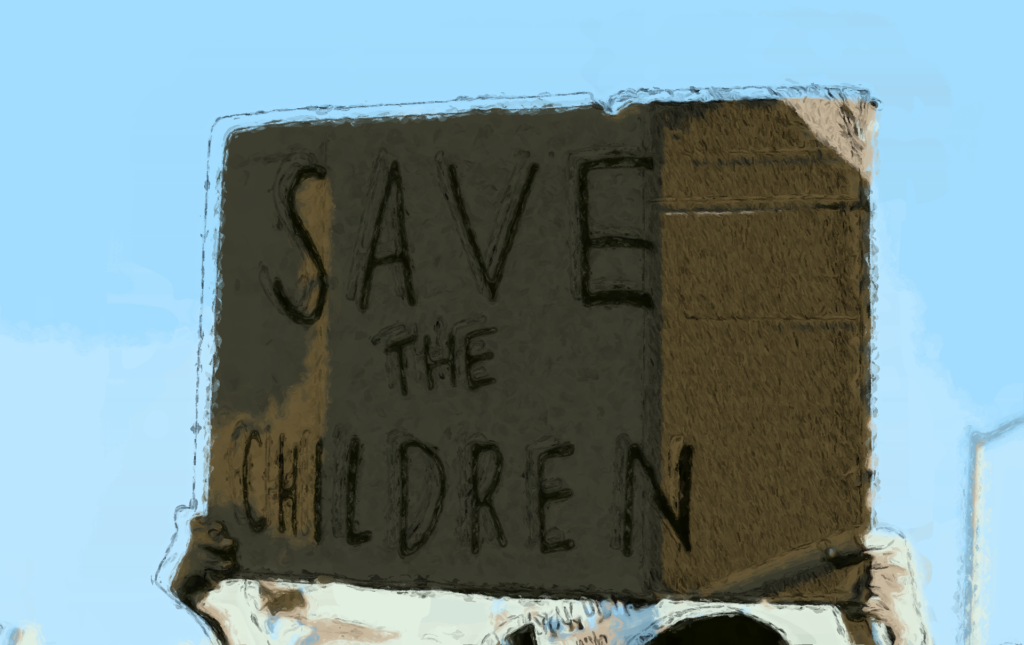
started life as a photo by Joel Muniz on Unsplash. I assume, based on date, that this is an anti-vax/anti-COVID-mandate thing. I don’t know, I just needed a clear sign that was a bit vague out of context.
Definitions and the weight of definitions are wild and easily manipulated. For instance, conspiracies by definition 100% exist and are 100% exposed — often to surprisingly little actual impact unless murder is involved somewhere and maybe not even then — on a regular basis. Let’s call these conspiracies — definite participants with definite consequences — “Tier One.”
Tier One Conspiracies: Business as Almost Usual
Company A teams up with Place B to snatch Resource C from the inhabitants. Some rich someone has an area [or company] declared low value before buying it up. Smaller scale ones where groups of people plan out crimes. Large scale ones where countries devalue a target to take over trade routes.
This is before you get to stuff like MKUltra and other exposed government plots/programs to do stuff outside of standard channels of morality/expectation. These are probably getting close to what I consider “Tier Two,” which will come up in a bit.
Let’s call this extreme “Tier Three.” In principle, there is a indefinite amount of agents involved and the goal seems something almost ineffable (insomuch as “Total Control” is ineffable). Like the agents behind Tier Three conspiracies are attempting godhood. Thinking about that, I’m going to propose “The Fourth Element” and discuss it in brief, down below.
There are varying lists of elements involved on this other extreme (see the European Commission’s page about COVID conspiracies to see a specific flavor), to which I would point out three (from my experience) as being deeply related to the fourth:
Manichean divide between GOOD and BAD and I don’t mean just simply “naughty people” but a sense that these people are akin to Biblical portions of BAD
Importantly: A keyhole where people who know can look through the door but said keyhole is not so obvious that it is just “clear as day” to your average person
The (often) lack of clearly defined morality, the (often) singular- or few-facet structure, and the fact that real Tier One conspiracies (usually) get spoiled violate these tenets. There’s a game to be played with conspiracy theories by my Tier Three definition where True Believers can see a bit further into the darkness and plainness.
Which brings us to the fourth element, the one I consider the key, the actual test of this tier three definition:
A conspiracy theory of the third tier is essentially indistinguishable from a religion requiring faith, an inner circle, ritual language, and a reshaping of worldviews and stems from the same part of our brain that processes religious conceptualization
THE OTHER is mostly conceptualized outwardly from THE SELF, so that different adherents will believe in variations based on their own personal history; though adherents will subscribe to the belief they are are using their faith and secret language to expose objective truth
There are GOOD OTHERS and BAD OTHERS talked about in dehumanizing terms, each, with the important that some OTHER AGENTs are on the side of goodness — generally the “side” of the conspiratorial belief holder themselves — and some are against it
Believing that billionaires will manipulate the market to improve their own profit margins is not, by the Tier Three definition, a conspiracy. It is plain. It involves known actors doing a possible-to-actually-know thing. You could give evidence clearly that all adherents can appreciate.
You would need to believe they are doing it to bring about an ineffable end, some great ritual, some mystic passing. In this, people who are part of the shadowy world will be both fighting for and fighting against the common person. Some billionaires will be the good ones. Some government agents will be exposing the truth behind UFOs. There will be codes and secret signs left behind.
However, I am left with the sense that there are broad movements and there are general shifts by powerful players but not codified in quite the same way. What if snack companies push less-filling, brightly colored snacks not because they are working for Satan (to ape a chain letter of many years ago) but because they want you to get fat and feel like a loser for not choosing one product from one of their subsidiaries over another of their subsidiaries?
Towards a Tier Two Definition
Which is making me wonder if there’s not space for a Tier Two definition:
TIER ONE: DEFINITE agents for a DEFINITE purpose.
TIER TWO: (largely) DEFINITE agents for a perhaps DEFINITE purpose but through INDEFINITE instability.
TIER THREE: (largely) INDEFINITE agents for an INDEFINITE or DEFINITE purpose (but usually the DEFINITE purpose is a facet of a much larger INDEFINITE one).
Look, it’s a broad musing and a work in process. I know this is fallible. I’m chewing on it. This is the part of the canvas where I have to throw paint all over the room just to figure out which colors match. Much like the algorithms that push various problematic memes to see which one stick and be manipulated into generational trauma…
*wink*
What I’m wondering, though, is if you could have a group of people — maybe not precisely known at present but in principle definitely knowable with clearly defined lines — who interfere with things, perhaps in definite ways, usually with a definite goal, but with indefinite consequences.
Which is wrong. Throwing paint, like I said. It’s more like…
Generating indefinite instability in order to generate certain types of behavior in the short or long term with the assumption that some classes of people are more immune to large and small scale instabilities.
One odd aspect of this “Tier Two” is that…
It’s not necessary for every agent group to be actively working together, just that they are participating in trends towards instability
A Tier One conspiracy would be like, say, a tobacco company or conglomerate of said companies making cigarettes more addictive. A Tier Three would be tobacco companies making cigarettes more addictive so that people absorb more chemicals and become conditioned towards government mind control backed up by a shady group of academic elites.
This type of Tier Two I am talking about would be various companies following trends of marketing and science to general make their product more addicting but then also paying for advertisement and education against addiction to harm competitors but also to increase distrust in science and regulation amongst their addicted regulars. Either they win by creating tribal-like brand dependency or by having people eventually thinking that “both sides” are problematic.
Oil companies making broad statements against renewable energies while also co-opting and sometimes controlling green initiatives for instance. Where wind power’s actual impact on local ecosystems can be treated as just-as-bad-as the extinction level event that fossil fuels can represent.
Promote veg*nism and a move from factory farms? That’s racist.
Algorithms pushing coverage for relatively minor infractions by environmentalists vs an over-emphasis on largely meaningless gestures. People being bullied for personal responsibility over the environment catastrophe vs people being portrayed as powerless against effective change (aka “the paper straw” strawman bullshit).
Co-opting “freedom of speech” as a way to attack personal freedoms. Or changing the meaning of “fake news.”
AI discussions where complaints or praises of it mean nothing because your average user cannot do a goddamned thing either way. Right up to complaining about the em-dash and oxford commas and all the other ways anti-AI sentiment is being used to dissolve standards of human communication. And yes, I filled this post with hand-coded — just to be pissy. I had to click extra for that shit.
Where Gen X was sold both anti-establishment and pro-establishment media. Anti-intellectual and pro-intellectual media. Told to trust the scientists we were told to mock as eggheads. Told to trust the government we were told to hate. Told to eat the food we were told to hate.
Where the only consistent thing was that we were told to consume.
To choose sides. To choose no sides. To engage. To be enraged. To qualify things that should be quantifiable. To quantify things of indefinite qualities. Where even the “generational system” of organization — Gen X, Millennials, etc — is nothing but bullshit pseudo-science to make us feel like we are striving for a horizon that has never existed. And if you complain about the labels? There’s a label for that, too.
“Here’s a box, get inside, please. Oh, don’t like the box? Me too! I hate boxes, subscribe to my newsletter!”
Because in the end that’s all that matters. Not the stance that we take. Not that we take a stance. There’s no stance we can take. As long as internalize it, though, as long as we think the stance or lack of stance is a thing, we consume. Just to show them.
That’s what I’m talking about. Where it’s not just about the doubt vs belief, identity vs the unknown, embracing conflict vs finding compromise: it’s about how we internalize these things and keep clicking more links. Thinking we have to fight but never quite knowing what it is we are fighting (plot twist: we are fighting our wallets to sign up for more online services, quite often). Thinking we are doomed but we might as well be playing on the Titanic and then getting fucking furious at people for playing on the Titanic while not thinking they are doomed in the exact same way.
We end up terribly judging who are just as intellectually complex and emotional extant as ourselves because the goddamned algorithm needed there to be an A and B or what the hell is A-B testing for?
I have to go chew on this and make more sense on approach two, assuming I get around to it.
I don’t know who in their right mind thought it was a good idea to let me have so many green-tea-and-gins last night but they were a complete idiot.
Name probably rhymes with bug or rug or something similar.
Funnily, it wasn’t the gin that was the real problem. Had I mixed 2-3 shots of gin with a liter of water and drank that I’d probably feel pretty swell today. It was the couple of liters of green tea that kept me up to something like 03:00.
One year I’m just going to go to bed for New Year’s. Since Belgian parties are just getting started at midnight, it probably won’t be for a couple of years, mind.
It’s a gray day in Grimbergen which is just sort of saying, “It’s a day.” Kind of nice, though. Not too cold. Not too loud. Windy in a pleasant way. Noon but feels either earlier or later. A kind of liminal space.
I’m sitting here next to two open windows letting in 5C air and giving a thought to the standard thought that we all do on 1 Jan: resolutions. I swore off the whole thing a few years back, mostly, but sometimes they are fun. Sometimes they are hopeful.
A couple of other bigger ones in a more general sense of things (since crowdfunding is pretty much 100% tied into my solo roleplaying hobby) are (a) reducing gamification in my life and (b) generally increasing privacy awareness. And (a) is going to impact a lot of other potential resolutions.
“It’s Going to Be Our Year!”
Before I get to that, let me give you some insight into the core Doug experience. Last night, after getting the first green-tea-and-gin in myself, I started sending out pre-Happy-New-Year’s messages to a few friends and while the messages tended to be personalized, in very nearly all of them I joked about the phrase, “This is going to be our year!” Those who get my sense of humor appreciated I was both making fun of arbitrary goalposts and whispering the foulest curse of them all: hope.
It helps you have say it with a shaky voice like a person saying, “Maybe the cave troll isn’t home, we should go into the dark cave and find out.”
Joyfully nihilistic curses aside, maybe it will be. I don’t know. I just take things as they come, mostly.
(a) Reducing Gamification
This is frankly the biggest one for mental health and general well-being. I have no specific numbers (which feels like a pun) but the gamification of every single aspect of our life feels like it is increasing. Earn points for purchases. Day-week-month streaks in every app. Add five friends to earn a point. Allow GenAI to access your data? Well, we’ll do it anyhow but if you give it away you can get a badge to show off on your profile that no one will ever click.
I pay money to upgrade the “freemium” experience of Duolingo, Geoguessr, and NYTimes Games. All three are big about pushing daily plays and uses [“Please stay addicted to our services”]. Badges. Achievements. I “buy” (lease? not sure what the proper legal term would be) books on the Kindle and it sends me notifications about not letting my streak expire. When I started deleting social media, I was seeing it more, there. Stuff that has no business setting weekly/monthly/annual goals have started bundling it.
Back 20 projects on Crowdfundr.ai? You get platinum status. There are no benefits but still we love you like your parents never did. Spend $2000 on gachas? You get 1.25 points per $100 spent instead of just 1 point.
It’s an incessant noise. And the fact that so rarely do hitting any of these milestones unlock anything besides maybe meaningless in-game currency shows how effective it is to just offer up a hexagonal png to keep people reaching for a goal that only exists to increase company profits through addictive behavioral programing.
When I was first workshopping this resolution, I thought about flat out cutting out any app or system that had such systems baked in only I realized, relatively quickly, that I would more or less be able to not access the things I actually use.
Instead, the idea is to simply ignore the badges, achievements, streaks, and other stupid bullshit designed to increase addiction. If I didn’t read today, no more panic reading a chapter to keep my Kindle streak going. If I don’t feel like doing Duolingo, just let the streak die. In some cases, this will likely be tied into getting rid of some freemium upgrades. So it goes.
The irony of this is that it kind of negates the concept of resolutions. I do want to read more. Play more of my old favorite games. I want to solo play more. Take bigger risks. Lose weight. Work on fixing my ankle.
I will likely have to compromise to some degree. It can be hard to lose weight without tracking calories somewhat. It can be hard to budget better without a budget.
Just absolutely no apps to do the data for me.
(b) Increasing Privacy
Which brings us to the other major resolution. Find ways to increase my overall privacy. This one is harder to specify without sounding a bit like a conspiracy nut. Or, perhaps, it is easier to specify:
Stop giving private information to unlock upgrades,
Use more offline stuff and fewer things that require third party tracking,
Avoid using cloud-based systems more, especially now that so many cloud-based systems have decided that using them is akin to giving your personal documents to their AI systems,
Using my own storage back-up solutions, own media servers, own email servers, etc.
Using more encryption that isn’t designed to expose the data to the host,
etc
There are so many little ways this one will show up. It makes me think of something that Northerlion (the Twitch Streamer) said. He mentioned that getting cash from the ATM feels like a borderline criminal act because you get the cash and then no one really tracks how you spend it. The sense that if we just use the stuff we own, we are going dark.
After the move to Belgium, I have been watching more stuff streaming from my personal server and through physical media, partially because I would have to use VPN to watch my American-media-libraries despite paying a lot of real money to build them up and still being an American citizen.
And one of the aspects of this is that when I put in that DVD/Blu-Ray/CD then no one but myself really knows what I am watching or playing. If I play a CD a dozen times, it doesn’t get tracked and used to sell me something. I can watch a movie a dozen times and it is up to me to watch trailers to see what else I might like.
We’ve been so conditioned to accept The Algorithm(TM)’s “help” to fill every waking hour with media that we are giving up the ability to own these pieces of happiness. It is becoming increasingly obvious how much companies don’t want us to own our own media now that I kind of have to own it to enjoy the things I enjoy.
Just look at videogames. Now you buy a code in a physical case and you attach that code to your account and if that library every goes away, you bought a physical case in a store to temporarily lease a game.
Or movies where you buy a blu-ray and they want you to use the “free digital copy” code so they can keep better track of who has what. Some Blu-rays and DVDs have features that require you to access the internet to see fully.
“If you are not paying for it, you are not the customer,” is a lie. You are the customer, always, but also the product. It’s kind of up to us to set the line and we are currently losing and pretending its inevitable.
If you want to just see an explanation of the issue, you can skip to THE TECHNICAL ISSUE, below. First, I get to rant a bit and give some context.
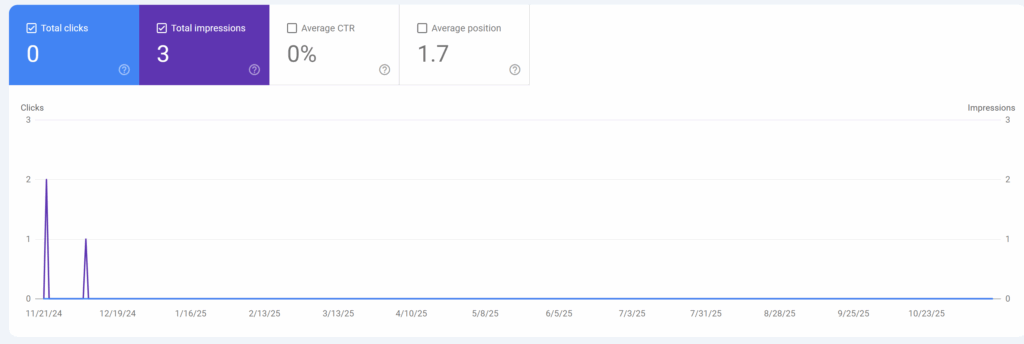
When I first returned to blogging after eight years, it was not with a traditional blog: it was with The Doug Alone PROLOGUE. It was a place for me to post notes and recaps about the solo rpg stuff I was doing.1 Only there was a problem. I actually mentioned it on my final post on that blog. Google more or less refused to index it.
It looks like it did at least briefly index a single page and then wiped it later.
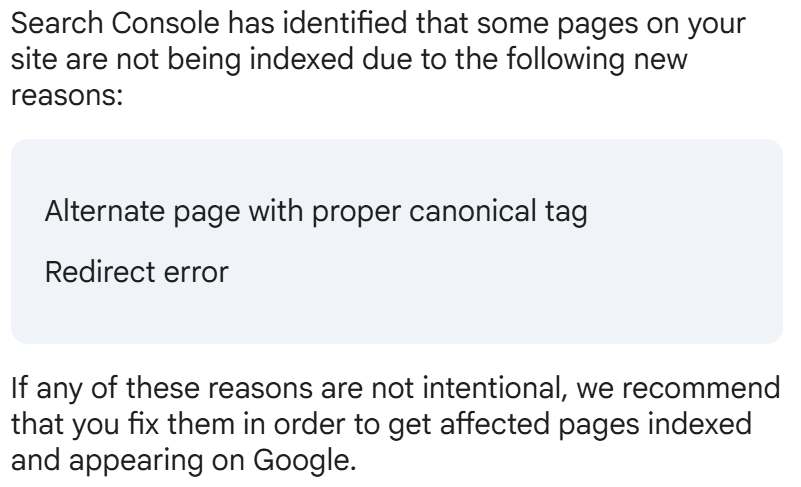
Even though the blog was primarily meant as a play journal, there were elements that I wanted people to find. Only there was a primary error that kept showing up by way of explanation:
Here’s the tl;dr: I am right. The SEO experts are wrong on this one. Neener neener.
I knew I was roughly correct. I’ve worked with a lot of different web platforms over the years and am well aware that Google is a fickle beast when it comes to promoting something (say, a one-off post about carpet beetles) over things that are more core to your blog identity (such as old posts about a variety of horror movies). However, months of Google flat out ignoring a blog with unique content was not consistent. At least a few pages would have passed The Algorithm.
Those more in the know of the technical issues probably know, and I had an idea but just not why Blogger/Blogspot was being hit by it. Had I cared more, I would probably have put it together earlier. Would I have still moved blogs? Oh yes. I like having my own space to play.
The Technical Issue
What’s the issue?
Webpages can have canonical tags. It’s not required. It just helps Google (and other search engine type things) to say that the page with the listing is the page you want to index. If you are on a platform where your content might bounce from page to page, you can use it to say that this is the correct page.
EXAMPLE: You have a cooking blog. You have a set of pages with different recipes and other pages that include snippets of those recipes and you don’t want Google to send folks to the pages with only the snippets (such as a category page or a front page that shows the most recent). You prefer your recipes to be front and center. You put the canonical tag on those pages.
In the specific case of Blogger/Blogspot, there’s a bit of code that basically tells each new page to have a tag on the post itself:
<b:include data='blog' name='all-head-content'/>
One aspect of this is to drop a simple line that gives the URL and says “this one, Google” in the <HEAD>:
And that should be well in good except for a technical glitch on Google’s side. It does not scan the blog like a person on a home computer will. It scans largely as a mobile device. And Blogger/Blogspot, a GOOGLE PRODUCT, tries to be helpful by serving up a ?m=1 version of the page. Old themes did not have a native mobile version. Newer ones do, but the artifact from Ye Olde Times is still there.
Which means that Google gets a link like this for the page linked above:
You can likely see where this is going. If you click on it, it is identical to the previous page, except the rel='canonical' is not pointing to that link, it is posted to the .html, not the .html?m=1 version.
This means for every Blogger/Blogspot page scanned, Google sees a page constantly serving up alternate pages and because the ?m=1 keeps persisting, it constantly fails to find the canonical pages.
What’s the Fix?
Unfortunately, the two primary fixes are both on Google engineers and since this has been brewing for a few years, I have no idea if they will fix it. Hopefully so, because Blogger/Blogspot is a nice all-in-one blog for people who don’t want to fiddle too hard and just want to get their content out there.
FIX #1 would be for Google to not treat ?x=y as wholly different pages at least in the case of mobile pages where the canonical link has identical content. I appreciate there are lots of cases where it is different content, but there should be a way to prevent that.
FIX #2 would be for Blogger/Blogspot to stop appending the ?m=1 to mobile pages. There are better ways to handle that. That feels like an artifact from 2010 era internet. Back when you had completely separate mobile sites. Ah, I remember those days unfondly.
What can we do as users of the product? I’m not sure. If you look, there are suggestions for Javascript workarounds. I am attempting to use the script at this page. Go gently into that night and double check before you use it, yourself.
I also did try updating my robots.txt file to tell Google to ignore ?m=1 pages. Will it work? I don’t know. I’m not precisely holding my breath. If I remember to check in a couple of months and it has worked, I’ll let you know.
Obviously, if you want to use that you want to change the final line to be whatever your blog’s address is. I’ve seen variations of that across multiple posts so I don’t know where it originated. Apparently older Blogger blogs had a baked in robots.txt but mine didn’t. I had to add it whole cloth.
Let’s see what the outcome of this double approach might be.
NOTE: It is possible that Google will eventually scan it via a non-mobile-first scanner and make all this a non-issue. Just 16-months seems like a fair time to run a test.
There is a paradox of solo play where a lot of folks, myself included, have a strong urge to share it with someone. The initial idea was not a blog. I thought about streaming some stuff on Youtube. Since I ended up figuring out a lot of mistakes, tweaking a lot of notions, and so forth: I am glad I went for a format that did not involve me just sitting there confused and sweaty on camera. ↩︎