

The past couple of days, the Youtube Algorithm has been extremely insistent that I want to watch this specific video:
A quick-and-Dougly summation for those who can’t/won’t watch: Hidden Rabbits was trying to find out how to read more books and stumbled upon a discourse/debate about folks skipping most of the books [in this case, just reading dialogue but I have heard of other techniques] and uses that as a lever to pry open issues with reading goals. Ultimately, Hidden Rabbits takes the stance of reading goals are good, being too hard on yourself is bad, some people are just better readers, and only reading dialogue is objectively bad. A few other tidbits ramble here or there in his discourse.
Books and I
Now this is something that sparked a LOT of thoughts in my head because I have been part of the online-book-sphere before there was a -Tok or a -Tube to fast-track the labeling process.1 I have seen the same arguments repeat forever like the whole thing is just an expression of liminal horror.
Perhaps most germane to all this is I sold books for years before becoming a librarian for nearly two decades (and, initially, had planned to retire as one before the international move).
I have had somewhere in the easy triple digits of people (frankly, probably easy quadruple digits of people) come up to chat with me in person about books, have attended formal lectures. All that. And a topic which echoes from grad school to the book store to the informal gathering has been “the right way to read.”
Ebooks? Reading goals? Young adult fiction? Graphic novels? Books over certain reading levels? Is The Lord of the Rings a book for children?2 All variations of that theme. How do we judge the way some people read as being right or wrong while largely forgiving ourselves for our own reading sins?
I’m now a bit past those days but it is a good to refresh myself every now and then so I want to riff off some points but FIRST an absolute CAVEAT: I think Hidden Rabbits bounces back and forth a lot and ends up into some rough waters here or there which are sometimes at odds with other things he says. There’s bits about some people having more free time. About the pretention of certain books. About the comparative “weight” of chunky fantasy vs thin (?) non-fiction. Stuff about owning books and whatever. It feels a bit freeform.
I link not because I agree (or disagree) with it but because I always appreciate when people talk about stuff like this even if I come from a different place than them.
SECOND, a less-binding CAVEAT: I generally consider a lot of the machinations of Social Media + Books to be ultimately a problem rather than a solution.3 I am not here to condemn BookTok (-etc) and I am sure there are many people that have found a wonderful community but in my experience you cannot have a gathering of readers without paradoxically generating what is effectively an anti-intellectual/anti-literary discourse.
I cannot explain it it just seems to bend that way.
The [Not Precisely] Wrong Way to Read
There is a bit where he says he doesn’t want to yuck anyone’s yum, but…
Frankly, I would have stopped my sentence before the but and not tried to buckle down with establishing an objective measure of any wrong way to read.
Reading is a conversation between content creator and content consumer and what makes it so interesting is there exists such a wide sea of possibility even for relatively plain reading. A person who comes across Lord of the Flies as a teen will likely be seeing, and should be seeing, a different novel than a person who reads it in old age. You start to understand it is barely a book about kids on an island at all.
That sea is real danged complicated. There is no precisely correct path to navigate it.
The only real problem I would have with “incorrect reading” — be it dialogue-only or only reading the first few sentences of each page/paragraph and all the other skimming methods — is when you are dishonest about this in order to try and hold some reading-superiority over others.

Beyond that, the notion of “the wrong way to read” ends up being a conversation stopper rather than starter. Like Hidden Rabbits says: some read slower or faster. To add to that, some read deeper or shallower. Some are unable to process fiction or non-fiction as well as the other. Et cetera.
By all means, make guidelines for what you do and do not want to do while reading. That is fine.
Just it was not too terribly long ago where people felt that audiobooks weren’t reading and by “too terribly long ago” I mean people still have this argument. See also ebooks. Certain genres. Certain print formats.
Extreme example but what about a person who reads classics by randomizing the order of chapters and livestreams the experience of re-interpreting the book?4 That seems…interesting. Maybe thought provoking. But it completely violates the standard shape of reading.
A more pervasive example might be all the ways book consumption has been turned into content creation.
Going back to dialogue-only reading [which I doubt is all that common despite seeing at least two videos decrying it], it makes me think of graphic novels. Graphic novels have LONG been established an effective way to reach reluctant readers. A coincidence? Maaaybe.
There is simply no good way to draw a line even if I think many readers feel like there should be a line. I have styles of reading that do not interest me. I’m sure most of us do.
The best I can say is let reading meet you where you are currently. Cast a wide net into that sea of possibility.
Let other people mind their own boats.
Reading Goals vs Reading Schedules
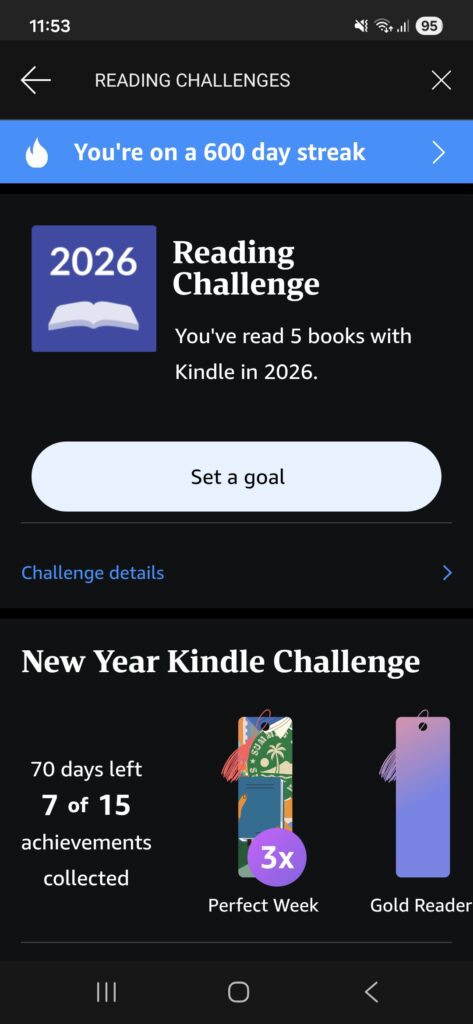
The other main point I want to talk about is reading goals. I’ve talked about them, before. I have my own reading tally here on this blog which is badly out of date. I guess I should fix that. Anyhow.
Reading goals can help certain people.
Like Hidden Rabbits says, though, it can be easy to slip out of alignment with them. Or to use various “tricks” to hit and exceed them.
My recommendation if you are struggling with reading goals is to instead try something like a “Reading Schedule”.
Rather than trying to read 30-50 books (whatever) per year, just make time on a daily basis to read. You can either set a length (e.g., one chapter) or time (e.g., 30 minutes) as a goal but the idea is to give yourself some flexibility and to just get used to daily reading as a habit.
I think annual reading goals almost encourages treat reading like an assignment and like an assignment we end up front loading a bit, taking a long gap, and then trying to rush at the end.
Reading schedules are more like a mental exercise.
The Truth about Reading More
I maybe should have started with this but here is a quick concept that explains the stupidly frustrating truth about reading more in a way that is almost definitely unhelpful to anyone finding this blog:
- (A) The only way to read more is to actually spend time reading more
- (B) Reading, like an activity, invokes an opportunity cost
- Therefore, (C) Actually reading more is going to come at the cost of other activities you could be doing
I think this ends up being a big stumbling block. This is partially why I don’t care so much about “the right way to read.” It is much easier for people to want to hit that place where they felt like a Proper Reader than it is for them to put down everything else — phone, work, other hobbies, TV, computer, videogames, whatever — and make a space to just enjoy that reading. Maybe a person is trying to return to those days when they would read in their room back at their parents’ house and feel like the future was endless but now it’s hard to find a book that returns them to that.
They are a different person now. The conversation they are having with books is different.
Especially for us old fogeys who might have read a lot back in the era when there were fewer constant distractions in our pocket and fewer screens dinging away at us with fewer gamified daily tasks we are supposed to accomplish.
I am not saying you have to gamify your reading — I’d rather you not — but maybe give yourself grace because it is an absolute fight and the main prize is just…reading. The end.
There is a lot out there. A whole lot. However you navigate that sea, paddle safely.
AND, and I cannot stress this enough, mind your own boat.
That is the only right way to read.5
- It occurred to me while writing that that there must be a Facebook-centric BookBook but I refuse to confirm or deny or its existence. I’ll let it live as a beautiful thought in my head. ↩︎
- I lie a bit. The person did not ask but instead furiously insisted that LotR was a book for children with her two criteria seemingly (a) it had no sex scenes [i.e., adult content] and (b) I think the fact that it was fantasy. ↩︎
- A couple of years ago I clicked on a BookTube video about “reading lesser known works” and the criteria was something like “Less than 4k (2k?, whatever, too many) reviews on Goodreads” and I legit can’t imagine ever wanting something to be reviewed by thousands before I considered it viable. ↩︎
- Live readmixing is the future. ↩︎
- “But, Doug, being pedantic about what other people read is how I like to read…” la de da. Congrats. You have trapped and confused me. Can’t argue against that, can I? ↩︎