
The third iteration of Doug Bolden's various thoughts and musings.

Category: Technology Page 1 of 2

Amazon Is Within Its Rights, But Eh…

tl;dr: Old technologies die and companies drive profits by pushing new ones, but at the same time, the warning of this is less about a specific company and more about a whole mindset. Kindles are fine, but you should have back-up plans.

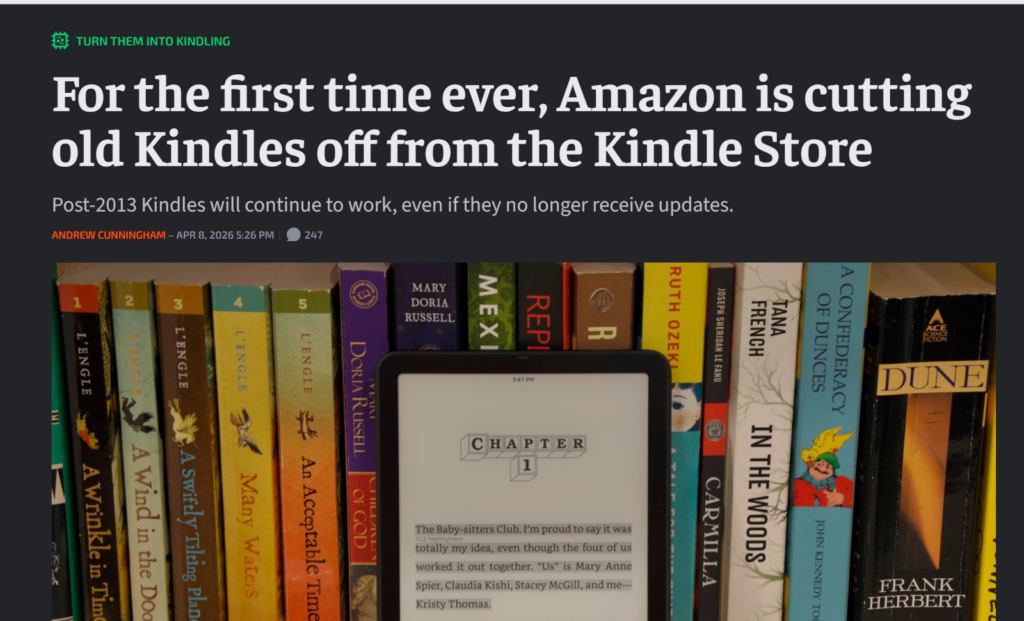
Above screenshot is from the top of ArsTechnica’s article: For the first time ever, Amazon is cutting old Kindles off from the Kindle Store. Which seems…strange. Not that they are doing it, but I thought they had already done something like this for older Kindles. I’m getting Mandela Effect’d in real-time.

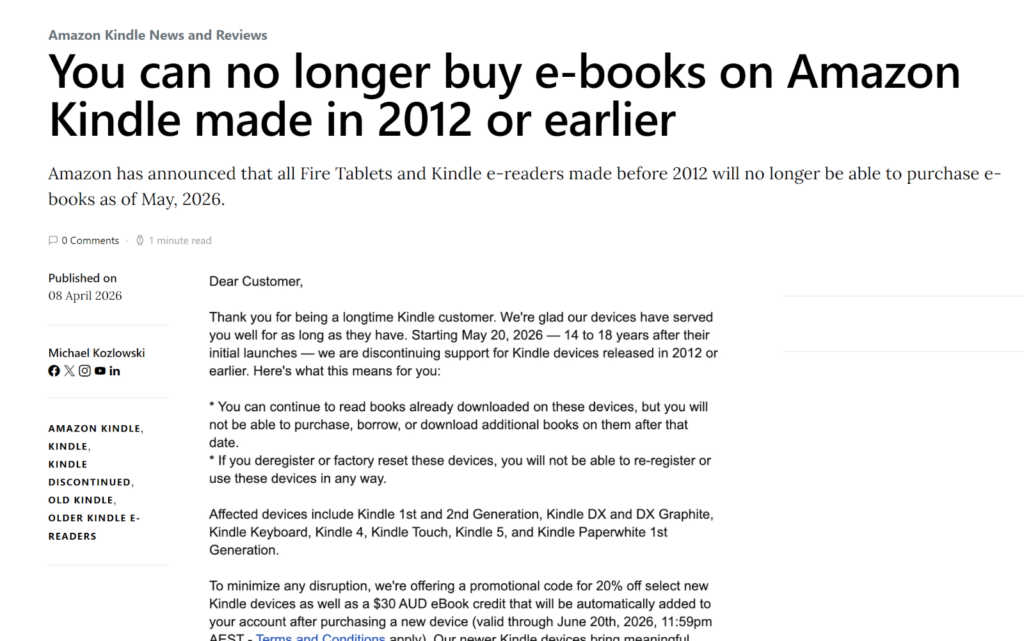
Anyhow, says AT references an article from Good-E-Reader: You can no longer buy e-books on Amazon Kindle made in 2012 or earlier.

Technically that’s [sic], as far as I know, since the purchasing seems to still be possible for the next month or so, but it’s a minor correction.

Another possible source if you just like to see various talk about the same tech news is not-shockingly the same way:

There are a variety of specific points brought up but it seems like consensus for the actual impact is:

  • You will not in any way lose your library, just the ability to connect said library to devices over 14-years-old.
  • The “bricking” they talk about seems to be more about books being associated with your account…
    • …which in some context is the same as “losing” them but there are mitigations.
    • …but in principle you could factory reset and still have a functional device by transferring books via cable.
  • A big impact seems to be people who use some variation of local public library collections and maybe [/maybe not] Kindle Unlimited type services, who might very well lose access to those.

My “first take” [for some definitions of first take, after spending an hour reading up on other takes and such] is that:

Amazon is 100% in their right to remove support for old technologies and hardware not up to date with current standards and future-plans, but at the same time PHHHHBBBTTTT.

Amazon is only going to lose (a relatively small amount of) face by this, no matter the reasons and this demonstrates the danger of the ownership-free future The Algorithm Class have been pushing.

[in 10 years you’ll still be hearing people talk about Amazon just stops supporting Kindles left and right much like how the 1984 incident back in…2010?…is still quoted as though it happens on a regular basis despite other bookshops being more prone to it]

Look, 2012 was a lot of time ago. Stuff that was brand-new in that era like Nintendo’s Wii U and Microsoft’s Windows 8 have already been sunset at this point (the former in a way no doubt similar to the what the early-Kindles are going through, still functional just not connectable to a shop or receiving device specific content). Computers and TVs from that era are different. Phones are completely different. Stuff changes and tech stuff changes significantly across 1.5 decades.

If anything, it’s a testimony to how well the old Kindles were built that the devices are functional enough that people are still attached to them…1

The fact that it is almost trivially easy to access your Kindle library through your phone or tablet or browser or through a computer app also factors into my somewhat lack of ire about this, though I still have ire.

Outside of the simple truism that old technology eventually gets forgotten [digital files last forever or five years, whichever comes first] my broad assumption that the DRM-wars are a big part of this decision. For whatever reason, we are in a world where ebooks are one of the most protected technologies and, in principle, harder to crack than music [often sold with zero DRM] and at least physical movies [which, if nothing else, can be played on a variety of players before you even get to ripping data from them].

Ebooks, especially Kindle-proprietary formats, and audiobooks [ditto, but Audible] undergo a constant push to innovate where a lot of the innovation is simply to stop people from breaking the DRM on the books they bought.

Piracy is real and has a real impact, but this confuses me to no end.

That is where absolutely any sympathy from me for any company, author, or anyone on the side of Amazon in this case ends. You should not have to rely on a third party to maintain your library and then be expected to buy upgrades to technology or sign away more rights just to re-read a book you bought [a lease to read] years ago. If you don’t want to maintain the library without snatching increasing amounts of personal data to build up into personas you sell to other entities, let us maintain our own. Books do not need DRM. If you are relying on anti-consumer tech to swim above piracy the sharks have already won.

All this being said, here are a few things that are semi-contradictory but I think are true enough to wrap up this kind of going-nowhere besides to take more pot-shots at the anti-ownership-driven future:

Promoting piracy in retaliation for this is a terrible argument. I’m old enough and been on the internet long enough to know that pirates are going to promote their auto-response to everything like it’s a…well, an auto-response. “Netflix increasing its prices? Pirate all the movies!” That kind of stuff. “Content creators barely get paid anyhow!” is the old workhorse that has been used in various forms for years and it remains as ignorant now as it was back then.

I 100% support anyone who uses technology to get around DRM to back-up their own library. Zero qualifiers. Don’t care about any contract or license or what have you. I don’t necessarily think they should have any rights to share it [but…] and especially not to make money off it but I should, and you should, have the right to make a copy of those files that does not require a specific device.

Promoting other ebook readers or even physical books is not precisely the answer. Books break. Folks who read 3-4 books a week will slam shelves full of books pretty quickly. Libraries and bookswap stuff is nice [I donate a lot of physical books] and I support that. Still, physical books are not necessarily going to have the advantages that some ebooks have even though they trump ebooks in other ways.

Other ebook readers are definitely an idea but if it involves simply buying into another ecosystem? Eh. I’d rather promote 100% open ebook readers or apps for common devices that can access all your libraries. See my second point.

I still like my Kindles. Though I am somewhat not in the target audience for this outrage since I tend to update my Kindles semi-often, every three-to-five years. I put them through a lot of wear and tear. Also, I’m the sort who would rather update my ebook reader than get a new gaming console or even a new phone.

Technologies will continue to die by design and a shift towards anti-ownership will continue to try and strip of your rights. Full-stop, the end.

  1. …even though a non-zero and possibly non-minority of the loudest complainers are folks who absolutely do not use old Kindles for various reasons. ↩︎

Chewing on a Proper “Self-Hosted” Web-Sphere: Very Early Thoughts

Photo by Nick Karvounis on Unsplash

It wasn’t technically Daniel Sell’s “How to Stop Jumping Ship” that made me start thinking about the topic of this post, but that is a linkable resource that has some of the information that has filtered into my brain space:

How To Stop Jumping Ship
08 Mar, 2026

Almost all of us have been on the internet long enough to have had one of our essential community hubs go flying off into oncoming traffic. MySpace, G+, Discord (world weary sigh)? Facebook and Shitter's decent into I Have No Mouth, And I Must Scream? Dead and dying, the lot of them, and they take what little community they generated down with them every bloody time. I'm tired of wasting energy on rebuilding community ties over and over again, it's not an especially good use of our time and it means that those of us who are most comfortable with, or benefit the most from, a fractured, chaotic wider community benefit and rise to the top. Behold, the world.

Important bit from slightly below that:

So I propose…we just toss it all in the bin and go back to the beginning. Blogs, newsletters, IRC, mailing groups, and, sure why not, Usenet, go nuts…These things are time tested, functional even in the face of overwhelming lack of interest from the general internet, and are, most importantly, utterly unbreakable. A specific blog, irc etc etc might disappear, but that won’t take anything besides that one facet of a larger whole with it.

What actually started it was an email which was sent out to the Melsonia email list. Same sort of information, a bit more pithy:

Do You Have A Blog Yet?
 
'Cos you should. Social media is poisonous, drains all your finer impulses. Wastes energy you could spend being happy. So I made a webring and a blogroll to make me happy.
 
How To Be Happy Too
Go make a blog now. Even if all you do is post your campaign notes up on it, I wanna see it.
Join a webring. Yes, like in the 90s. People will find your blog and you don't have to do anything other than be you.
You can even add a blogroll to it, just like in the Google Plus times.
Post. Read. Post. Read. Delete social media. Post. Read.
 
Really, it's that easy. You don't need to be good or popular or cool. If anything, they're the worst people to have blogs. The uncooler the better, I say.

Pretty much everything in that image is in the above linked post, though one addition is very much in-line with the stuff I talk about here, which I’ll quote:

Social media is poisonous, drains all your finer impulses. Wastes energy you could spend being happy.

He includes a link to Bear Blog which I won’t include because I’m sure it is fine but this is not an endorsement of a particular product over the other and at a glance, the software seems to violate a couple of principles I’ll talk about in a minute.

If anything, this post is absolutely an anti-endorsement of anything that might be considered a product. Websites/Apps-as-products are killing us. Killing the earth. Killing creativity.

I Digress All Over The Algorithm

One caveat creeps up almost immediately: Sells and I are at least partially concerned about two different things. He seems to be largely talking about (a) moving towards a platform where ideas exist outside The Platform® and are not beholden to the constant drive towards enshittification and profits AND (b) coming up with something that trumps the Algorithm Class’s version of a good time. I like both of those things, both fit strongly in my Reclaim Ownership concept I have been discussing here or there on the blog, but I think for me there is something else brewing in my brain:

Stop treating the Algorithm Class like your friend: you are a commodity to them and the current internet is designed to take resources from you and feed your resources into their bank accounts [money they use to take more freedoms from you].

We are witnessing the death of ownership and are being manipulated into thinking we need them. In 2026, The Algorithm tells you you are bored, that you are unhappy, that you are worthless without The Algorithm, that your replacement worth is derived from the dopamine you get from participating in a rich-person’s profit margin. And we believe it…

Come and share! Like and subscribe! Upvote! Get your five-year streak!

We live in a world where we give third-party companies all the content that makes the platform worthwhile but then you give up increasing rights to your own creations as they rapidly change the rules. They don’t even ask nicely. They just have your college friends’ content being held hostage and you are lonely.

AI amoebae demanding access to our creations. Less control over what we can share versus keep. Free-fall user unfriendly design based around selling digital baubles. Digitally engineered loneliness and disease. All the other terrible aspects forced upon you while specialists in behavioral modeling outsource whitepapers to tell the owners of the servers how to maximize profits from your work.

It’s Big Tobacco all over again. Paying experts to make things more addicting while telling us they are just giving us a product we really want and rumors of your own addiction are greatly exaggerated.

With the bonus that it’s not only our creations, but often the core of our friends and family groups being held for ransom. “Keep smoking and you can keep talking to your mom back home!”

THEN, they take extra data from you and sell it.

It’s like the worst possible version of the peer-review process. That process has volunteer writers being edited/scored by volunteer editors and volunteer peer-review committees. Then the output is given freely to scientific publishers who generate substantial profit off making it available. With the consequence of not publishing can include missing out on tenure and promotion.

Only instead of contributing to the ever-expanding world of valuable science, we are simply trapped in a loop where in leaving a billion-dollar money maker we have no control over ends up with being branded as anti-social and distant. No party invites without social media. Missing out on collector’s items by our favorite brands because people on X got first dibs. How in the hell do we know what Florida Man is doing this week unless we spend hours each week doomscrolling through made up posts about Florida Man?

“I can’t leave Instagram, what about all my friends!?,” we say over and over as our data is stolen and the money generated from it is spent to lobby for war crimes. Taking your joy of expression and turning into AI slop generated in data centers so environmentally unfriendly they are altering ecosystems while unwriting decades of copyright and intellectual property law.

Don’t say, “If you are not paying for it, you are not the customer.” That’s tired. Sad. Ignorant. You can pay for it all day long and to The Algorithm Class you are just money and never enough.

Besides, you are very much paying for it and its the most expensive purchase you have ever made.

Like cats, there is no free social media. We are collectively paying billions of dollars to avoid going to bed on time. Our tax money spent to subsidize The Algorithm Class. In return, The Algorithm Class buying out a large portion of our governments for their needs. Every lost ecosystem and plot of land to build data centers. We are spending generational wealth indirectly to look at ads on Facebook.

And the saddest thing is that for all this money, you and your creations are worthless to them individually. Sold for pennies. A penny today so they can buy congressfolk to not pass privacy laws and make a dollar tomorrow.

That’s the thanks you get. Being sold for $0.03 on loop with no protections just so hackers can get your national ID numbers and ruin your credit while the data hoarders say, “oops,” and face no consequences.

There is no ceiling that will stop folks from generating profit off of your hard work and there are very few protections to keep you from suffering the laziness of their vibe-coding neglect.

I DIGRESS.

An Early Thought Experiment Towards Doug’s Ideal Web-Sphere

The point is that reading Sells’ post made me think about how hard it would be for me to actually get any of my friends and family on board with creating a web-ring or similar. I could probably get two or three signed up but the siren call of the wide-open for-sale web would hang there. We are two decades into the social-media-and-search-engine revolution that has stripped us of a properly free internet.

This means this is all in the heady realms of though experiment, so taking that as an act of freedom rather than problem, I was thinking of things I would like to see if I could back and shove Myspace off a cliff.

  • An actual emphasis on creator ownership, not just virtue signaling. No caveats or catch-EULAs where you give up the rights.
  • An emphasis on self-hosting or hosting done by entities where you pay them real world money to host your data and in exchange they treat it as hands off for any other use unless they pay you to use your data.
  • Related to above, but you are free to take your data whenever and wherever you please. Zero retention in a third party and absolutely no “a third party sold your stuff to another third party that has no contract with you explicitly” unlike the current real world problem.
  • “Censorship” and moderation are generated at the hands of the end-user through tools easy to read and use.
  • No advertisements unless the content creator is getting paid a substantial portion of the fee [let’s say 80+%] and at their behest [yes, this means content creators will have to pay to post stuff].
  • Multiple media streams — text, microblogging, video, audio — can be handled by servers optimal to them, each chosen by the content creator.
  • No addiction-behavior models. Discovery layer predicated by the needs and desires of the end user rather by a creation of any sort of presumed force.
  • In fact, there would be optimally many many end-user tools that have their own approach to discovery and moderation.
  • Anonymity vs ID exposure decided by content creators.
  • Absolutely NO Upvotes and, perhaps most controversial, probably NO comments posted to your own data stream [they would be posted to the commenter’s data stream]. The idea is to break apart the Skinner Box variation of the internet [as described here or there by Cory Doctorow]. You will not get algorithmically friendly shiny cookies. You share data and information and art: others can read it and watch it and enjoy it. SEO is the mind killer. SEO will pass right through you. When SEO is gone, all that remains will be memes.

In other words, something where people create content streams through many different self- or creator-focused-hosted methods and something — webrings, RSS/Atom feeds, metadata chunkers, your own eyes and fingers — will handle this and there will be no fake digital commons generating billions of dollars in revenue as long as you keep playing ball and getting your grandma to sign up for an account.

No lectures from AI-generated moderators about how you need to tweak your content to maximize conversions.

Hell, there would be no conversions. Death to the trust-economy. No product of The Algorithm Class has earned the right to addict us and constrain us to the information/data/consumption-complex they have chosen.

You decide what you want to read and no one knows what you do with it but you.

The Tower of Babbling Replies

There are a few “Explain the Joke” subreddits on reddit and most, probably all, are trash-tier karma farming circle jerks. Just absolutely awful.

The same easy-as-shit jokes or rage-bait memes are posted over and over with people showing up in the thousands to comment. Sure, some of the replies are just bots joining in on the blatant karma manipulation. Which is fitting since it is likely mostly bots posting them. Bots and people trying to farm a few easy k karma to kickstart a reddit account so they can then sell it to bots.

In fact, you could probably automate a script to block every person who ever makes a post in one and trim a fair number of crap from your reddit experience.

Some of the replies are just going to be people who can’t help correcting others or sharing their thoughts, even when the same posts show up once a week or less. It’s weaponized tribalism versus default redditor behavior.

It is especially painful because posts from a couple/three of these subreddits frequently drift to the popular feed which dirty little no-accounts like me are forced to browse without extensive bookmarks: which might be the point. Let the shit float so people are forced to make an account just to have the tools to block them. Eh. Every day is a gift.

HOWEVER, you do occasionally get gold despite the massive attempt by gravity to pull sanity off a cliff. Like this one asking about the Tower of Babel made in [not-]LEGO [look at me violating my “never link to reddit or any social media” rule].

Pardon the proximity to a pun, but my brother in Christ, what could we possibly explain? I can get folks posting references to obscure-but-knowable things with a bit of a gate-keep to even knowing search terms. Sure.

Things like the Tower of Babel might not be universally known but when the immensely searchable words are right there….

At any rate, like all good circle jerking on reddit, the scant pretense of actual joy is people running with it and the replies are full of people posting answers [some on point] in various languages….and some people then trying to argue about the true meaning of Babel. Which is like the true meaning of Dollar Store kitten calendars. It’s aliens, my man. All aliens. All the way down.

Bonus, someone ended up inserting a Hail Mary joke which will make no sense until you’ve read maybe the first quarter of the book, but still.

*jazz hands*

I look forward to this above image becoming a post on this same subreddit in a couple of days.

Is It Time for the Surprised Pikachu Face?

from the NPR article, Your data is everywhere. The government is buying it without a warrant:

A whole industry of data brokers buys up vast quantities of electronic information from cell phone apps and web browsers and sells it to advertisers who use that data to target ads. The same industry also sells that data, including bulk cell phone location data, to police departments and federal government agencies in ways that can reveal intimate details about Americans without a warrant.

Now, privacy advocates say that the best chance for Congress to close the well-known loophole around the Fourth Amendment that allows for that sort of governmental snooping is coming up in just a few weeks.

That’s when Congress is expected to take up reauthorization of what is known as Section 702 of the Foreign Intelligence Surveillance Act, which is set to expire on April 20.

After a 2015 change to the law, federal agencies are not supposed to collect data on U.S. citizens in bulk. But some found a workaround to requesting warrants by simply buying the data instead.

I’m actually neither shocked nor awed. Pikachu face can stay in the desk drawer. There are funnier uses for the meme. This is why I get so frustrated by conspiracy theorists. The real world changing conspiracies tend to happen in the open but are discredited by the same media and enterprises complicit in their existence [but not, you know, actually hidden].

Best bit is that AI-companies owned by the Algorithm Class is the real clear winner, here. They get paid to digest the human experience en masse to better train their LLMs by selling the data to entities that treat this data as different from protected data despite being the same data.

I have no precise takeaway here or anything to add besides to say that if our data is worth billions to someone, it should be worth [collectively] billions to us. The same way that if information wins war then information should be considered protected by the second amendment.

We’ve entered into a strange new horizon where companies revel in increasing the cost of doing business with them by, with very little choice, forcing a lot of us to give up vital aspects of our own liberty [namely the ownership of our own identity].

“If you are not paying for it, you are not the customer,” is dead, long live:

You are now never the ONLY customer.

The Algorithm Class demands a Commodity Class, and we be it.

Contemplating a Different Type of Conspiracy [Broad but Indefinite | Indifferent]

started life as a photo by Joel Muniz on Unsplash. I assume, based on date, that this is an anti-vax/anti-COVID-mandate thing. I don’t know, I just needed a clear sign that was a bit vague out of context.

Definitions and the weight of definitions are wild and easily manipulated. For instance, conspiracies by definition 100% exist and are 100% exposed — often to surprisingly little actual impact unless murder is involved somewhere and maybe not even then — on a regular basis. Let’s call these conspiracies — definite participants with definite consequences — “Tier One.”

Tier One Conspiracies: Business as Almost Usual

Company A teams up with Place B to snatch Resource C from the inhabitants. Some rich someone has an area [or company] declared low value before buying it up. Smaller scale ones where groups of people plan out crimes. Large scale ones where countries devalue a target to take over trade routes.

This is before you get to stuff like MKUltra and other exposed government plots/programs to do stuff outside of standard channels of morality/expectation. These are probably getting close to what I consider “Tier Two,” which will come up in a bit.

Tier Three Conspiracies: The Fourth Element

However, these “Tier One” conspiracies are differentiated from a different sort. I am not going to do math because it is almost impossibly complicated, but for at least some folks, perhaps most folks, this is not what is meant when you encounter the word Conspiracy Theory.

Let’s call this extreme “Tier Three.” In principle, there is a indefinite amount of agents involved and the goal seems something almost ineffable (insomuch as “Total Control” is ineffable). Like the agents behind Tier Three conspiracies are attempting godhood. Thinking about that, I’m going to propose “The Fourth Element” and discuss it in brief, down below.

There are varying lists of elements involved on this other extreme (see the European Commission’s page about COVID conspiracies to see a specific flavor), to which I would point out three (from my experience) as being deeply related to the fourth:

  • Manichean divide between GOOD and BAD and I don’t mean just simply “naughty people” but a sense that these people are akin to Biblical portions of BAD
  • Shadowy, secretive cabal of multi-faceted interests: government, business, press, science, industry, religion (“It goes deep!”)
  • Importantly: A keyhole where people who know can look through the door but said keyhole is not so obvious that it is just “clear as day” to your average person

The (often) lack of clearly defined morality, the (often) singular- or few-facet structure, and the fact that real Tier One conspiracies (usually) get spoiled violate these tenets. There’s a game to be played with conspiracy theories by my Tier Three definition where True Believers can see a bit further into the darkness and plainness.

Which brings us to the fourth element, the one I consider the key, the actual test of this tier three definition:

  • A conspiracy theory of the third tier is essentially indistinguishable from a religion requiring faith, an inner circle, ritual language, and a reshaping of worldviews and stems from the same part of our brain that processes religious conceptualization
    • THE OTHER is mostly conceptualized outwardly from THE SELF, so that different adherents will believe in variations based on their own personal history; though adherents will subscribe to the belief they are are using their faith and secret language to expose objective truth
    • There are GOOD OTHERS and BAD OTHERS talked about in dehumanizing terms, each, with the important that some OTHER AGENTs are on the side of goodness — generally the “side” of the conspiratorial belief holder themselves — and some are against it

Believing that billionaires will manipulate the market to improve their own profit margins is not, by the Tier Three definition, a conspiracy. It is plain. It involves known actors doing a possible-to-actually-know thing. You could give evidence clearly that all adherents can appreciate.

You would need to believe they are doing it to bring about an ineffable end, some great ritual, some mystic passing. In this, people who are part of the shadowy world will be both fighting for and fighting against the common person. Some billionaires will be the good ones. Some government agents will be exposing the truth behind UFOs. There will be codes and secret signs left behind.

However, I am left with the sense that there are broad movements and there are general shifts by powerful players but not codified in quite the same way. What if snack companies push less-filling, brightly colored snacks not because they are working for Satan (to ape a chain letter of many years ago) but because they want you to get fat and feel like a loser for not choosing one product from one of their subsidiaries over another of their subsidiaries?

Towards a Tier Two Definition

Which is making me wonder if there’s not space for a Tier Two definition:

  • TIER ONE: DEFINITE agents for a DEFINITE purpose.
  • TIER TWO: (largely) DEFINITE agents for a perhaps DEFINITE purpose but through INDEFINITE instability.
  • TIER THREE: (largely) INDEFINITE agents for an INDEFINITE or DEFINITE purpose (but usually the DEFINITE purpose is a facet of a much larger INDEFINITE one).

Look, it’s a broad musing and a work in process. I know this is fallible. I’m chewing on it. This is the part of the canvas where I have to throw paint all over the room just to figure out which colors match. Much like the algorithms that push various problematic memes to see which one stick and be manipulated into generational trauma…

*wink*

What I’m wondering, though, is if you could have a group of people — maybe not precisely known at present but in principle definitely knowable with clearly defined lines — who interfere with things, perhaps in definite ways, usually with a definite goal, but with indefinite consequences.

Which is wrong. Throwing paint, like I said. It’s more like…

Generating indefinite instability in order to generate certain types of behavior in the short or long term with the assumption that some classes of people are more immune to large and small scale instabilities.

One odd aspect of this “Tier Two” is that…

  • It’s not necessary for every agent group to be actively working together, just that they are participating in trends towards instability

A Tier One conspiracy would be like, say, a tobacco company or conglomerate of said companies making cigarettes more addictive. A Tier Three would be tobacco companies making cigarettes more addictive so that people absorb more chemicals and become conditioned towards government mind control backed up by a shady group of academic elites.

This type of Tier Two I am talking about would be various companies following trends of marketing and science to general make their product more addicting but then also paying for advertisement and education against addiction to harm competitors but also to increase distrust in science and regulation amongst their addicted regulars. Either they win by creating tribal-like brand dependency or by having people eventually thinking that “both sides” are problematic.

Oil companies making broad statements against renewable energies while also co-opting and sometimes controlling green initiatives for instance. Where wind power’s actual impact on local ecosystems can be treated as just-as-bad-as the extinction level event that fossil fuels can represent.

Complain about fossil fuels? Why do you hate small communities in Africa?

Promote veg*nism and a move from factory farms? That’s racist.

Algorithms pushing coverage for relatively minor infractions by environmentalists vs an over-emphasis on largely meaningless gestures. People being bullied for personal responsibility over the environment catastrophe vs people being portrayed as powerless against effective change (aka “the paper straw” strawman bullshit).

Co-opting “freedom of speech” as a way to attack personal freedoms. Or changing the meaning of “fake news.”

Algorithms that highlight catastrophizing and doom-scrolling. Creating a media landscape where brain-rot short-form media is both becoming a default and also complaining about it is becoming a default.

AI discussions where complaints or praises of it mean nothing because your average user cannot do a goddamned thing either way. Right up to complaining about the em-dash and oxford commas and all the other ways anti-AI sentiment is being used to dissolve standards of human communication. And yes, I filled this post with hand-coded — just to be pissy. I had to click extra for that shit.

Where Gen X was sold both anti-establishment and pro-establishment media. Anti-intellectual and pro-intellectual media. Told to trust the scientists we were told to mock as eggheads. Told to trust the government we were told to hate. Told to eat the food we were told to hate.

Where the only consistent thing was that we were told to consume.

To choose sides. To choose no sides. To engage. To be enraged. To qualify things that should be quantifiable. To quantify things of indefinite qualities. Where even the “generational system” of organization — Gen X, Millennials, etc — is nothing but bullshit pseudo-science to make us feel like we are striving for a horizon that has never existed. And if you complain about the labels? There’s a label for that, too.

“Here’s a box, get inside, please. Oh, don’t like the box? Me too! I hate boxes, subscribe to my newsletter!”

Because in the end that’s all that matters. Not the stance that we take. Not that we take a stance. There’s no stance we can take. As long as internalize it, though, as long as we think the stance or lack of stance is a thing, we consume. Just to show them.

That’s what I’m talking about. Where it’s not just about the doubt vs belief, identity vs the unknown, embracing conflict vs finding compromise: it’s about how we internalize these things and keep clicking more links. Thinking we have to fight but never quite knowing what it is we are fighting (plot twist: we are fighting our wallets to sign up for more online services, quite often). Thinking we are doomed but we might as well be playing on the Titanic and then getting fucking furious at people for playing on the Titanic while not thinking they are doomed in the exact same way.

We end up terribly judging who are just as intellectually complex and emotional extant as ourselves because the goddamned algorithm needed there to be an A and B or what the hell is A-B testing for?

I have to go chew on this and make more sense on approach two, assuming I get around to it.

And Thus…I Leave Feedly

Sigh.

Just a few days ago I was going through a multi-hour process to disentangle from OneDrive and now, for reasons, I’m doing the same thing for Feedly. Some of it is similar. A recurring cost that offers little real value compared to what I can do myself. A company that considers its AI-arm to be its true innovation. Features and elements I like being de-prioritized over a different type of client than I am.

And while Feedly is different in several ways…

  • OneDrive is more integrated into the default Windows experience
  • Feedly genuinely is one of the best feed readers out there, while OneDrive is not necessarily one of the best cloud-based storage systems
  • Feedly is a lot more “optional” than proper file management, even if very helpful
  • I would say that Feedly is actually innovative in its interface, even if I don’t need most of it

…it still hit an irk in me this morning.

I went to search for something. The above picture shows me searching for “dice1.” That’s not what I searched, initially, [it was “daylight savings time” which glitched it out] but it will do for a demo.

I had to click several things to tell it “just my feeds, please” instead of “Feeds & All Web” and then to unclick the defaults of “Business & Strategy” and “Tech Blogs” as well.

After which, I got the worst search results since Bing was initially launched.

I could only see, nearly fully, the “top result” but not click on it. Every other result is faded out and hidden. In fact, they are not search results at all. They are dummy results slapped behind a “disabled-entries” flag.

I can’t even tell if this is just some sort of hiccup in the system or if they really expect me to upgrade to Pro+ just to be able to search by classifying “search” as “follow” which are two different sorts of tasks.

It for sure has encapsulated what should be a fairly simple task as a “Feedly AI” worthy one. If you go all the way back up to the top, you’ll see the “Feedly AI” tweaked my search options to generate more results…none of which were usable by me. Outside of that, if I search for something in my feeds and there are no results, I want there to be no results. I’m not just idly passing time. I’m trying to use information.

Keep in mind, there used to be a fairly user friendly, intuitive search feature just a little over a year ago. One I am pretty sure wasn’t locked behind the Pro/Pro+ features. I was Pro, then. In fact, I joined Feedly in August (?) 2016 and joined Pro around a month later. And kept it, at the actual ridiculous fee of around $7us/month for a decade.

I should have bolted when they started going more in on Enterprise level tasks rather than just serving a product that worked.

At any rate, spent around an hour researching private and self-hosted type feed readers and began migrating stuff over (including finding a fun glitch where CloudFlare keeps killing some OpenRSS feeds).

Will probably delete my entire Feedly account soon. They can have MBAs using AI models to track awful crypto blogs be their customer base if they want that crowd so badly.

Going Back to Check…it is designed worse than I thought

So I went back before clicking post because I wanted to make sure I wasn’t missing some obvious checkmark. I might still be missing some check mark, but, I am pretty confident that I am not missing an obvious one.

Some things I learned.

Feedly still brands its search as “Across Your Favorite Sources” on the home screen…

heh, “easily.” “Just fifteen clicks to not get any results! easy!”

…then changes up the language once you get to the search page.

Note that most of those are AI searches rather than just a simple search across data.

Technically you can see THREE of your results, you just have to check them all and save them to a board

Note, you have to believe that the checkbox exist and just mouse over it. The fun thing about “3 articles selected” (and with some testing, it seems to always be three articles returned for a search) is that it means there is always a completely hidden-in-fog article down below for absolutely NO reason since it’s just white, no-display space. They are literally wasting server and browser processing time to show you something that isn’t there. It’s probably something to do with needing extra space to get the proper fade on the gradient. Or just plain madness.

“Yesterday on the stairs, I met a Feedly search result that wasn’t there…”

That’s…just awful. That’s some serious tomfoolery.

Yeah, deleting that account very shortly.

NOTE: I have not tested the app and right now don’t care to test the app. I’d rather just delete than waste any more time on this. Maybe it works as expected, there, but none of these things suggest good things about the future of this product.

  1. I don’t know which is worse, the fact that it assumed I was searching for “DICE” the company and tagged it as a company search OR the fact that it absolutely did not matter since it just did a keyword search anyhow across my feeds. Terrible. ↩︎

“Deleting” OneDrive…

One of my promises to myself for 2026 — which admittedly feels a bit “puny” with everything going on — was to redraw from most cloud-based storage. Part of the broad “clean up!” phase of my mid-life crisis…

  • Leave social media
  • Leave [most] third party cloud-based storage [Google Drive is something of an exception, for now, and I have other specialty storage to handle certain accounts and servers]
  • Reduce streaming subscriptions to a minimum
  • Generally stop paying for services I can do myself with some sweat/tears

…which, when written like that, does sound a bit like I’m turning into a paranoid old codger. I am, that. But also, it gives me a challenge. Something to chew upon.

Today was OneDrive. I had some variation of the Office 365 subscription— which is now something like Office 365 Copilot — where I had apps, storage space, improvements to email, and upgrades to “freemium” MS stuff like Copilot++ Extreme Teams Plus™ or whatever branding makes the shareholders happy. I don’t know. The fact that I never knew what kind of value I could possible be getting from most of it is part of my problem.

Which is part of your problem, MS people.

Any Microsoft folks seeing this, that’s my feedback. Help me to feel like I am getting much more than $100 out of such a thing if you want me to keep it. Make it feel like you are giving me the sweetest deal ever. You ain’t a charity. You ain’t a college student just working your way up through the world. Impress me.

I got said annual subscription a few years back when I got this computer and continued, like a good little puppet, to pay the $100ish annual fee for all these many months. As we were prepping a move to the EU, I cut out most of my annual/recurring payments to stuff that wasn’t absolutely necessary, keeping only a few with some of those few on the eventual chopping block. This included my Office 365 [insert other branding terms, here] subscription though I figured I’d keep it if I wanted it after all.

If and only if I felt I was getting my value.

In the interim time, I set up more of my own storage, switched most/all documents to LibreOffice [etc], and started handling my email largely “in house.” In short, I absolutely did not need to pay a trillion dollar company $100 to do those things for me. Which left a problem.

There were roughly 500gig of files on my computer tied to OneDrive. Not paying meant my OneDrive was stuffed full to the brim — 9000% over the limit, the warnings said — and stuff was throwing errors. I logged in and started to delete out my files from the online side and then went…

…because while I doubted it, there was a non-zero chance that I was about to trigger Microsoft deleting half a terabytes of files off my PC. Good files. Stuff like my pdf copies of Outgunned and my Two Steps from Hell music. That would have made me sad having to redownload all that.

I stopped, looked into it, and figured out that I had to go through OneDrive’s settings and then stop syncing each of the major folders. One at a time. Which takes…time. It moves the folders around and changes the links and stuff. A few folders with only a gig or two worth of files might be quick but my main Documents folder which had 300gig alone took the better part of an hour. Then sit there in fear that it was simply going to delete those files outright [Ron Howard voice: it did not].

That’s before I had to go through and update some bookmarks, rebuild a music library in Foobar2000, and related things. Piece by piece.

Doug’s Note: There are walkthroughs already written for this process. I should have taken screenshots on the way down but didn’t think about it until later.

After I did all that, and dealt with all the errors, I then “resynced” and that deleted the files off my online account. I then deleted out a few more bits and then unlinked my account from OneDrive and then exited OneDrive.

Which has twice tried re-opening and which prompted Windows Defender to lecture me about the importance of having online backup, etc.

My primary annoyance since then is that the Default Library Folders — Documents, Pictures, Downloads, Videos, Desktop — are now put into kind of janky library containers in the “Libraries” tree at the bottom of the left-hand panel and there doesn’t seem to be a way to build a more functional version of that towards the top to match the older style.

In other words, paying for OneDrive put all those files into a convenient place in the panel which doesn’t seem possible, without possibly editing the registry, to replicate. That’s…madness, right? That’s purposely nerfing their own operating system to sell a side product.

Hey, looking for a book to read? Let me just suggest something. Probably totally unrelated to this whole experience:

I ended up just making “Quick Access” links to those folders, a few others, though it seems like Windows 11 keeps wanting to trim those out.

All this has made me really miss Linux all the more.

The [Super] Universe is Healing…

In the sheer inanity of modern existence, where every day is a slam between the mental load of simply considering an international conspiracy of terrible people on one side and the wryly chuckling at “boop-gate” on the other…

It is sometimes nice to see the same fights show up about fansubs as always.

Ah, that takes me back. Logging into IRC channels and getting reamed because you make a joke or ask about the process. I one time asked about the process of fansubbing a series that was on a kind of on semi-pause1 and the ensuing argument out of nowhere ended up with an announcement that “despite rumors, we have not dropped this series.” No shit. I was just curious.

Ah, 2003-2004 era TV-Nihon, I kind of miss that level of jack-assed-ness. Seriously TVN folks, thank you for the memories.

超 100% means “super” in this context, as backed up by all of the hype [heh, pun], press, and most likely some official release somewhere down the road that I’m ready and willing to slap down pre-order button upon when I get the chance. As in a reference to the Super Sentai series that Gavan is “replacing.” As in the kanji used in numerous Super Sentai productions which calls-back to that meta-series name. It’s an homage. I thought it was a nice touch.

A loving handshake to a venerable series that has lasted for multiple generations of childhoods.

Still, fansubbers and fansub-fans arguing about such things is like… it’s the universe healing, you know? Something lost from my youth and taken up by a whole new generation.

  1. Actually, I think it was more like the series was still be subbed, but they were sharing the files via a different method? I don’t know, that was 20 damned years ago. Specifics escape me. ↩︎

600 Days…

Today, I hit this count…

All five of those read books, and the book I am currently reading, are Dungeon Crawler Carl. The first couple of books started out as roughly reasonable in their page count and the later ones have grown to books of a certain size. The sixth one, the one I am currently reading, is close to eight-hundred-pages long. I think the seventh one is similar.

At any rate, I have no good “number of pages read” metric to say off the top of my head and won’t get up to do the math but I’d wager that “more than three” will suffice as a page count total.

One of the earliest posts on this rebuilt blog was about hitting the five-hundred-days-of-reading mark. I included some caveats, there, that are still roughly applicable. The past century of days has tended to be more legit reading, hitting somewhere between fifty- and two-hundred-pages per day on average, but many of the points are otherwise valid.

I’m still refusing to make any specific goals, but I do appreciate the irony that letting go of caring about shiny made-up medals is helping to actually do more of the hobbies I like.

The Future Is Now

I made a [hopefully slight] mistake, Space Pilgrims. In the sheer metric tonnage of things to do prior to moving, I forgot at least one important step.

from a photo by Haley Truong on Unsplash

There’s a company, a tax company, that Kaz and I have worked with for years. As our finances have gotten more complicated, they have they have been great to us. I don’t want to precisely name and shame them—*cough* *cough* Z&5 tycTM *cough* *cough*—but let’s just say that you could come up with an almost-a-pun if you said, with a bit of a swollen mouth, sketch and draw block.

Like a lot of accounts, our account with them is deeply associated with an email address. And in this case, the email was deeply associated with my old job. I had notes to myself, “Doug needs to change this specific email address for {x, y, z, etc},” and in a lot of cases I did.

I think I started to change it there, but when I try to log in to start the annual Joy in Taxes Ritual, it wants my old work email to let me sign in. Despite insisting, in the out of date online help pages, that there should be a button I could button to use another way to verify who I am, said button does not even have the dignity to face me as a man.

So I call.

Pick up a phone and call.

Like an old person.

Only, now there is an AI assistant to help with the phone. Ah, the dream. The future. The slow erosion of all middle-class jobs to make sure there is an even bigger divide between the rich and the riff-raff.

*sips tea* Yes, yes.

At any rate, I smile because why not be nice to the unthinking digital monstrosity feasting on our good will and hopes for a brighter tomorrow, and I respond to the “How can I help you [fleshy creature]?” prompt and I say, in as clear of a voice as I can muster:

“I need help updating my email address on your website.”

This was followed by clicking and clacking sounds. To make me feel like it was thinking and typing out an answer. It went on for a while, so I had some hope that it was digging up some module to actually assist with my problem or at least give me follow-up sub-prompts.

….

………

….

……

“To update your computer, you need to make sure you have the right software…[detailed instructions on finding software as a concept online]…and then make sure your firewall is not blocking the upgrade and install…[some more advice, including contacting the company’s help line for all my tech support needs].”

It “heard” the word “update” and then gave me a response about updating my computer before then appending the standard “there is help available” by giving me the information I had already used to end up in this conversation. It was both an endless loop and a sidequest.

Now, the company does have product-specific software. At least, I assume it does. Wait, let me check….

[pretend clicking and clacking noises]

…yes. It does. It seems like they have it updated through 2025 and I’m sure more AI bots are vibe coding the 2026 version right as we speak. Well, right as I type. I’m not saying this out loud or anything. That would be….crazy, right?

At any rate, while utterly unhelpful, it makes at least some vague sense if their average customer base is calling to ask for tech help and its having to start very basic on a whole.

Still.

The future is now.

After that, I simply said, “Agent, please,” and it made some more clicking clacking, told me human agents were only available from 7am to some other time CST, and then hung up on me.

Page 1 of 2

Powered by WordPress & Theme by Anders Norén