The new proposal would offer European users two choices: continue using free versions of Instagram and Facebook with personalized ads, or pay for ad-free subscriptions. The changes would not affect Meta app users in other countries, including the U.S.
Now, you could argue — if you are a sycophant who thinks giving billionaires your personal data is a fair deal just so you can continue to doom-scroll instead of taking up useful hobbies and getting more sleep — that giving up personal data for “advertisements” is easy. And free.
Got to love it when Meta tells its users that their data is worth €5.99 – €7.99 [I’ve seen two different values, quoted] per month. That much, huh?
Sounds like a great backbone for a really big lawsuit to recoup all the stolen value from content creator’s hard work currently being funneled into AI-training machines.
The use cases stated in the press release were AI features such as translation, transcription, and document summaries. However, this would just be the start; AI is coming for your e-readers whether you like it or not.
I think Michael Kozlowski’s line there at the end is perhaps the only truly pertinent one in the whole article, seeing how the AI space is growing so fast that a) hardware with AI “baked in” will be out of date on a much faster time-line that most e-ink/e-reader devices so these first sacrificial lambs will be in trash heaps within a year and b) the entire AI space is populated by a entire tessellation of pyramid schemes where certain people, once they achieve enough riches, might slow down enough to try and address the growing body of problems.
Since “when a rich asshole has enough money” is slightly less probable than “when pigs fly” or hell freezing over1, my personal assumption that generative AI will largely be fixed post some world-rending crash.
For now, the absolutely non-sense trillion-dollar valuations and projected growth worth more than most countries basically only works if folks keep rapidly adopting it. In a similar vein to how little people like myself (and yourself) were pulled into the stock market by sheer shitloads of late-90s, early-00s propaganda and now that action has propelled a few people into the spheres of worth where no international law seems to actually apply and every attempt to rein in said wealth leads to the billionaire equivalent of hissy-fits.
We have to feed at the Trough™ and…oh, look, just got another email saying my monthly Trough™ fee has been increased to €49.95 unless I allow advertisements on my Trough™ device.
Fucking wank.
The thing is I actually like the potential of the services this could offer. Things like being able to compare the linguistic choices between books, to see references to other books in a series (without wading to middling fan-wikis full of malware ads), get multiple translations, to look up historical events being referenced, to do deeper searches about concepts being discussed, to analyze charts and numbers, to check the veracity of claims… These could be good things.
But for now the folks who want you to want AI are not your friends.
You are the customer and the product. At the same goddamned time.
And far more probable than the bullshit claims that “eye of a camel” was really a secret code that means rich people are actually very, very loved by God. ↩︎
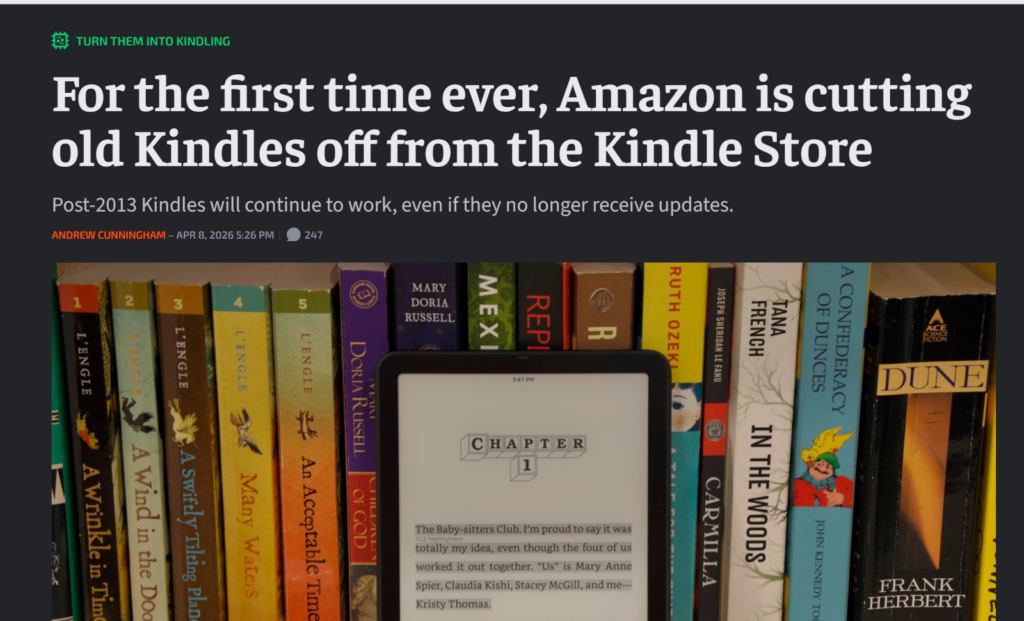
tl;dr: Old technologies die and companies drive profits by pushing new ones, but at the same time, the warning of this is less about a specific company and more about a whole mindset. Kindles are fine, but you should have back-up plans.
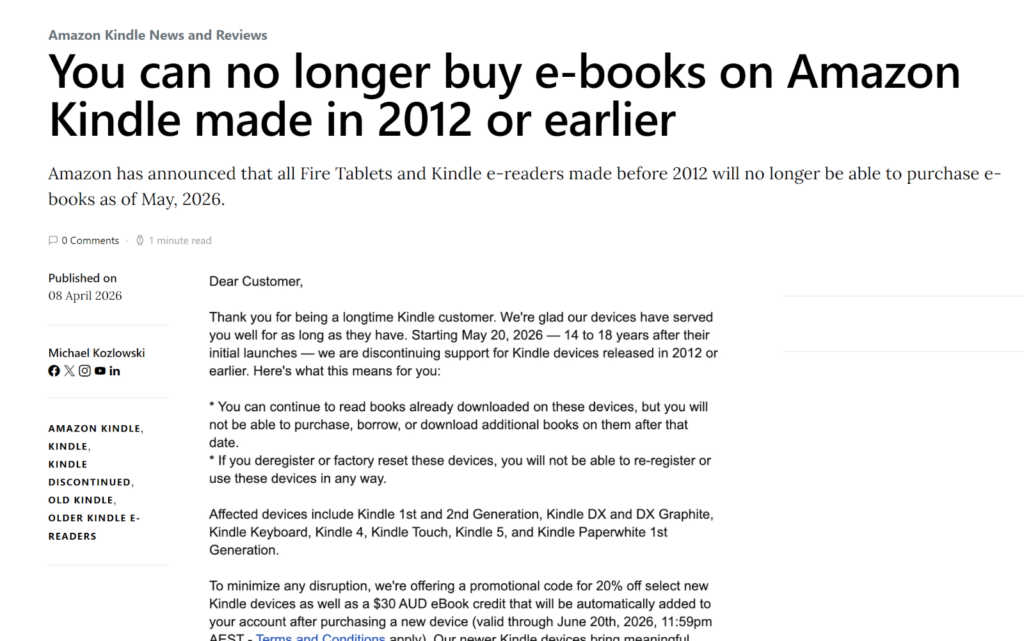
Technically that’s [sic], as far as I know, since the purchasing seems to still be possible for the next month or so, but it’s a minor correction.
Another possible source if you just like to see various talk about the same tech news is not-shockingly the same way:
There are a variety of specific points brought up but it seems like consensus for the actual impact is:
You will not in any way lose your library, just the ability to connect said library to devices over 14-years-old.
The “bricking” they talk about seems to be more about books being associated with your account…
…which in some context is the same as “losing” them but there are mitigations.
…but in principle you could factory reset and still have a functional device by transferring books via cable.
A big impact seems to be people who use some variation of local public library collections and maybe [/maybe not] Kindle Unlimited type services, who might very well lose access to those.
My “first take” [for some definitions of first take, after spending an hour reading up on other takes and such] is that:
Amazon is 100% in their right to remove support for old technologies and hardware not up to date with current standards and future-plans, but at the same time PHHHHBBBTTTT.
Amazon is only going to lose (a relatively small amount of) face by this, no matter the reasons and this demonstrates the danger of the ownership-free future The Algorithm Class have been pushing.
[in 10 years you’ll still be hearing people talk about Amazon just stops supporting Kindles left and right much like how the 1984 incident back in…2010?…is still quoted as though it happens on a regular basis despite other bookshops being more prone to it]
Look, 2012 was a lot of time ago. Stuff that was brand-new in that era like Nintendo’s Wii U and Microsoft’s Windows 8 have already been sunset at this point (the former in a way no doubt similar to the what the early-Kindles are going through, still functional just not connectable to a shop or receiving device specific content). Computers and TVs from that era are different. Phones are completely different. Stuff changes and tech stuff changes significantly across 1.5 decades.
If anything, it’s a testimony to how well the old Kindles were built that the devices are functional enough that people are still attached to them…1
The fact that it is almost trivially easy to access your Kindle library through your phone or tablet or browser or through a computer app also factors into my somewhat lack of ire about this, though I still have ire.
Outside of the simple truism that old technology eventually gets forgotten [digital files last forever or five years, whichever comes first] my broad assumption that the DRM-wars are a big part of this decision. For whatever reason, we are in a world where ebooks are one of the most protected technologies and, in principle, harder to crack than music [often sold with zero DRM] and at least physical movies [which, if nothing else, can be played on a variety of players before you even get to ripping data from them].
Ebooks, especially Kindle-proprietary formats, and audiobooks [ditto, but Audible] undergo a constant push to innovate where a lot of the innovation is simply to stop people from breaking the DRM on the books they bought.
Piracy is real and has a real impact, but this confuses me to no end.
That is where absolutely any sympathy from me for any company, author, or anyone on the side of Amazon in this case ends. You should not have to rely on a third party to maintain your library and then be expected to buy upgrades to technology or sign away more rights just to re-read a book you bought [a lease to read] years ago. If you don’t want to maintain the library without snatching increasing amounts of personal data to build up into personas you sell to other entities, let us maintain our own. Books do not need DRM. If you are relying on anti-consumer tech to swim above piracy the sharks have already won.
All this being said, here are a few things that are semi-contradictory but I think are true enough to wrap up this kind of going-nowhere besides to take more pot-shots at the anti-ownership-driven future:
Promoting piracy in retaliation for this is a terrible argument. I’m old enough and been on the internet long enough to know that pirates are going to promote their auto-response to everything like it’s a…well, an auto-response. “Netflix increasing its prices? Pirate all the movies!” That kind of stuff. “Content creators barely get paid anyhow!” is the old workhorse that has been used in various forms for years and it remains as ignorant now as it was back then.
I 100% support anyone who uses technology to get around DRM to back-up their own library. Zero qualifiers. Don’t care about any contract or license or what have you. I don’t necessarily think they should have any rights to share it [but…] and especially not to make money off it but I should, and you should, have the right to make a copy of those files that does not require a specific device.
Promoting other ebook readers or even physical books is not precisely the answer. Books break. Folks who read 3-4 books a week will slam shelves full of books pretty quickly. Libraries and bookswap stuff is nice [I donate a lot of physical books] and I support that. Still, physical books are not necessarily going to have the advantages that some ebooks have even though they trump ebooks in other ways.
Other ebook readers are definitely an idea but if it involves simply buying into another ecosystem? Eh. I’d rather promote 100% open ebook readers or apps for common devices that can access all your libraries. See my second point.
I still like my Kindles. Though I am somewhat not in the target audience for this outrage since I tend to update my Kindles semi-often, every three-to-five years. I put them through a lot of wear and tear. Also, I’m the sort who would rather update my ebook reader than get a new gaming console or even a new phone.
Technologies will continue to die by design and a shift towards anti-ownership will continue to try and strip of your rights. Full-stop, the end.
…even though a non-zero and possibly non-minority of the loudest complainers are folks who absolutely do not use old Kindles for various reasons. ↩︎